


Tuesday, July 23, 2019


Monday, July 22, 2019
Rainbow Arc of Fire at Comic-Con San Diego 2019

I want to personally thank each and every one of you who stopped by the booth, picked up one or more free books, bookmarks, hero cards and fridge magnets, and/or bought Rainbow Arc of Fire novels, over the course of Comic-Con's five days. Your interest in the series is most appreciated. In the future, when you get a chance to read one or more of these super-hero novels, a kind review (3 stars or better) on amazon.com is always appreciated.
Mark and I had a wonderful time meeting and interacting with all of you at the Con's 50th anniversary. Exhausted but unbowed, we are looking forward to seeing many of you next year where we will have more items to give away or sell.
I have commissioned one of the talented comic book artists at the Prism booth to create an action poster of all 12 RAoF heroes to sell next year (or give away with book purchases). Alas, the yellow--third--volume, SOULS WITHIN STONE, has joined the red and orange volumes in having the first editions disappear from stock. But, as always, the second editions are still available for all three novels.
I have commissioned one of the talented comic book artists at the Prism booth to create an action poster of all 12 RAoF heroes to sell next year (or give away with book purchases). Alas, the yellow--third--volume, SOULS WITHIN STONE, has joined the red and orange volumes in having the first editions disappear from stock. But, as always, the second editions are still available for all three novels.
Of course, all ten volumes in the series are available at highly reasonable prices on amazon.com as either print-on-demand paperback copies or even less expensive digital downloads. Your support is what keeps the team alive.
Again, thank you all for stopping by the booth and appreciating what we are attempting to do.
Be well and prosper!
Thursday, July 11, 2019


Monday, July 8, 2019
Air Force Academy 1978-9

It was this service for which I was being given the award, after 235 missile alerts under that state from late Spring 1974 through early Summer 1978. I'd gotten 7 Highly Qualified and 2 Qualified ratings while being evaluated by various Standardization Board crews at Minot over those several years of service.
The reason for this tentative walk down memory's dark alley is that my husband, while training in GA for his current government job, bought each of us a couple of T-shirts at the gift shop at the training base. Thinking that I would wear one of them to the gym yesterday morning, I took one of mine out of the clear packaging and stared closely at the lettering on the front of the shirt: "U.S. Air Force Office of Special Investigations", OSI for short.
There was a time, during the Spring and Summer of 1979, when the OSI was my ultimate nemesis, my Lex Luthor or Dr. Doom. And for most of those fateful months, I was not even aware that I was being investigated, that the career I had worked so hard to further was on the brink of ending. By extension, some of my friends, acquaintances, and colleagues at the Academy would also come under scrutiny.
Mark was aware of what I had gone through so many years ago, but I do not believe he had made the connection between my eventually being forced to resign from the Air Force and the role the OSI agents played in that resignation. The first volume in this Rainbow Arc of Fire series does detail some of what happened.
It was the OSI agents who had taken the notes each time the self-loathing cadet, Keith Bostic, came to their offices to recall what had happened when the cadet and I met at several times and in several places and just talked about being gay. It was they who had him create a hand-written note to me which they put in an envelope and dropped off on my desk in the English Department when I was at the gym during the lunch hour, a note that provided Bostic's home address, inviting me to write to him while he was home on leave--leave that I was able to get for him, leave to which he would not otherwise have been entitled. It was they who provided the rather large official report that was given to the Academy legal department and then, eventually, to me and my lawyers when the time came to defend myself against the many charges therein.
Unfortunately, it was those six letters to the cadet that doomed my career. No other proof existed that I was gay. In the letters, though, I had poured out my heart in writing to another man for the first time in my life. The most pathetic aspect of those letters was that Bostic only opened up the first letter and the last letter. The other four he received from me he never even opened. But the OSI agents, likely all straight and possibly homophobic, read every single letter, every single word of my feelings and emotions. My words probably disgusted them. But they dutifully photocopied them to include in the several copies of their report.
This was, of course, years before the current policy that allows us to serve openly (though Herr Trump is now trying to eliminate trans members from serving). This was also years before "Don't Ask; Don't Tell" came into play.
We had no protections then. None whatsoever. Gays and lesbians were not supposed to serve in the several branches of the military. We would destroy morale. We would be extreme security risks. The Russians would surely blackmail us into giving up national security secrets. We would easily become traitors to protect ourselves. (Let that sink in as you contemplate the ongoing Trump-Putin love fest.)
That June of 1979, I had finished teaching a summer makeup class for four cadets who had done poorly during the regular academic year. I was in the office of my supervisor who was in charge of the summer program when Col. Shuttleworth came into the cubicle and said that he needed to speak to me. I had no reason to feel alarmed.
I was scheduled to attend an advanced service school during the next academic year, Air Command and Staff School, I believe. I had already been chosen to co-teach the prestigious Academy television course, Blue Tube. I was likely going to be offered enrollment in a PhD program in a year or so, returning to the Department to work for a few more years of my career, likely able to retire after 20 years of service. My career was on the verge of soaring.
But like the Academy gliders attached to tow planes as they jointly soar aloft, I was about to become detached. Permanently.
On our puzzling walk to the Department's conference room, Col. Shuttleworth earnestly mentioned that there were two OSI agents there waiting who needed to speak to me. My heart instantly froze.
The OSI wanting to meet and speak to you was never a good sign. Someone was in trouble. I quietly vowed that if any of my colleagues was going to be accused of being gay, I would say that I had no knowledge of that.
I was quickly disabused of the thought that this involved anyone else after I was introduced to the two agents, Col. Shuttleworth left, and the three of us sat down. The one agent opened a brief case on the table in front of him and calmly told me as I became shocked by the contents staring up at me, "We have the letters."
He could have shot me with a pistol and I would not have been any more startled.
Never in my most insane musings could I ever have imagined that Cadet Keith Bostic had easily handed over those letters to the OSI. He had somehow been coerced. I thought that perhaps his parents had come upon them and forced him to turn them over. I never conceived of the fact that he had been going to the OSI regularly for several weeks. I would not discover that stunning fact until my first Air Force lawyer handed me a copy of the OSI's exhaustive, thick report a day or so later when the full truth of what had been going on was fully revealed.
"Under the spreading Chestnut tree/I sold you and you sold me." -George Orwell, 1984
Cadet Bostic had been going to the OSI of his own volition for weeks. We would later find out that he had first gone to an Air Force Chaplin who had advised him not to pursue the matter. He would ruin an officer's career, the Chaplin told him. Bostic did not heed the Chaplin's sound advice but then went to the OSI. Unfortunately for Bostic, he lied during the questioning of those agents, though they believed, and wrote down, everything he told them (they had no reason to doubt his sincerity). He would later lie to my two Air Force lawyers when they questioned him. In the report that I poured over several times after I got my hands on my copy, I eventually concluded that one third of what he had told the OSI were lies. One third of what he told them was distortions of the truth. Only one third of what he said was the truth.
The most damning lie was that I had tried to kiss him, against his will. (We had never kissed. We had never had sex. We hugged once. This was all new to me at the time and I was going very slow.)
The most damning distortion was that he implied that he was this innocent, totally straight Cadet who was being implausibly stalked by a predatory gay officer/instructor who was using his position of power to take advantage of him. If my attentions were thoroughly unwelcome, why did he continue to tolerate me as his academic advisor for so many weeks before and after he began going to the OSI? Why did he visit my house more than once? Why did we meet on several occasions in various locations to talk? Why did he come to the booth more than once when I was showing films to the Cadet Film Club in the Academy auditorium? Why did he put his arm around my waist the second time he visited me there? Why did he tell me over the phone, when I realized we were becoming too unprofessionally close so that I had asked another instructor to take over as his academic advisor, only to have him regretfully respond, "I never asked for that."
The most damning distortion was that he implied that he was this innocent, totally straight Cadet who was being implausibly stalked by a predatory gay officer/instructor who was using his position of power to take advantage of him. If my attentions were thoroughly unwelcome, why did he continue to tolerate me as his academic advisor for so many weeks before and after he began going to the OSI? Why did he visit my house more than once? Why did we meet on several occasions in various locations to talk? Why did he come to the booth more than once when I was showing films to the Cadet Film Club in the Academy auditorium? Why did he put his arm around my waist the second time he visited me there? Why did he tell me over the phone, when I realized we were becoming too unprofessionally close so that I had asked another instructor to take over as his academic advisor, only to have him regretfully respond, "I never asked for that."
The major problem for him was that Cadet Keith Bostic had told me that that name was not really his own. He had been adopted by a couple who had lost their only son and tried to replace him with this adopted son, using an expensive lawyer to facilitate the identity transfer. He had, according to him, gotten into the Academy solely by having this new identity.
The second major problem is that while, as a suspected homosexual trying to protect my career, I was not to be believed; Bostic had foolishly told other cadets pieces of the same story he had told me. Yet, when interviewed by my well-prepared Air Force lawyers, he denied ever saying any of that--to anyone. None of the story I claimed to have heard from him was true, he exclaimed to the two of them. But when you lie to Air Force lawyers, when you have told similar tales to cadets who have no reason to invent what they claim was told to them, and you have a Cadet Honor Code which proclaims, "We will not lie, steal, or cheat, nor tolerate among us anyone who does", you have cornered yourself.
The second major problem is that while, as a suspected homosexual trying to protect my career, I was not to be believed; Bostic had foolishly told other cadets pieces of the same story he had told me. Yet, when interviewed by my well-prepared Air Force lawyers, he denied ever saying any of that--to anyone. None of the story I claimed to have heard from him was true, he exclaimed to the two of them. But when you lie to Air Force lawyers, when you have told similar tales to cadets who have no reason to invent what they claim was told to them, and you have a Cadet Honor Code which proclaims, "We will not lie, steal, or cheat, nor tolerate among us anyone who does", you have cornered yourself.
Two religious upper classmen, who were friends of his and had conducted prayer sessions with Bostic in their dorm rooms before this situation unfolded, were also caught up in the investigation because he had told them things he should not have. Soon, my Academy lawyer revealed to me, "Now, everyone's got a lawyer." The OSI--when informed that their apparently reliable witness was now also under investigation for lying to them and to my lawyers--was also in a bit of a bind.
But for me, unfortunately, there were still those six letters.
And the authorities determined not to charge Bostic until I had been dealt with. (Given the ludicrous nature of the charges against Bostic, and involving the investigation against me in which I might have had to become questioned, the Academy staff decided not to utilize the normal Academy cadet honor violation process to charge Bostic.)
While all of this was going on, however, I was banished from the English Department and exiled to the Academy administrative building, Harmon Hall, to do routine paperwork--I was to be gotten out of the way. Bostic, however, was allowed to attend classes as if nothing was happening.
One mid-day, early in the process, while I was still working in the English Department, I was summoned to Harmon Hall--it might have been the time I was asked to be fingerprinted. I decided to walk across the Terrazzo, the open area between the dorms and academic and administrative buildings and mess hall. I was met by a couple of my students who had heard something of what was going on. Soon, more cadets joined them. Then more. As some would depart for class, others would take their place. At one point it appeared to me to be at least a dozen or more surrounding me and voicing support. When I finally had to leave but mentioned what had happened to my Academy lawyer, he said, "It's a good thing the Commandant [of Cadets] hadn't seen that."
Eventually, Cadet Keith Bostic was forced to resign from the Academy for breaking the Cadet Honor Code. My resignation would follow a week later.
Almost exactly forty years ago.
And yet I cannot remove that personal tragedy from my life and expect that I would be here where I am today.
I would not have realized that it was forty years ago had Mark not bought that T-shirt that I wore to the gym yesterday morning, almost as a badge of defiance.
As I believe I said in the first book, A Mile-High Saga, I have come to realize at some point along the way that it was not the untrustworthy Cadet who had knocked my career and life off course. It was I who had prevented such a dishonest individual from graduating from the Academy and having a career that could have engendered more loss than one officer's career.
As I believe I said in the first book, A Mile-High Saga, I have come to realize at some point along the way that it was not the untrustworthy Cadet who had knocked my career and life off course. It was I who had prevented such a dishonest individual from graduating from the Academy and having a career that could have engendered more loss than one officer's career.
https://youtu.be/srtCRYR3SoY
Kiki Dee, "One Step" from her 1978 album STAY WITH ME.
Monday, June 10, 2019
The family in White Cloud, 1988


The bottom photo is Uncle Lloyd, Aunt Jean, Cousin Doug, Uncle Robert, me, Aunt Doris and a neighbor. We are all standing on top of Robert's hill on the South edge of town, with the grain elevator and the Missouri River behind us.
Seven people in the top photo, and every one of them is gone. Seven people in the bottom photo, and every one of them is gone except me. "Just for a moment we're all together; just for a moment we're happy," says Emily when she spends a portion of a day from her previous life, Thornton Wilder, OUR TOWN.
In high school, when it rarely rained but did and we were in PE and could not play out of doors, we were hustled into the gym to participate in a brutal game of dodgeball. My friend Richard Meyers would stand perfectly still and quickly take the hit so he could move to the sidelines right away and no longer have to participate in the "game". I was like most of the others, trying so hard to keep out of the path of the flying ball (that actually did not hurt too much when it struck you). But when the other side had the ball and one particular guy got control of the ball and was ready to hurl it hard, the opposition would scatter as much as possible so as not to be hit. I'm not so sure that the last one standing meant much in that game, but nobody but Richard seemed to want to get hit too early or at all.
But I look at these pictures of the family and lament that every one depicted is dead. They slept and awakened so many times over the course of those lives that were significant to them and the rest of us, and one day they no longer did. Eventually no one survives. But you keep trying to dodge the ball and survive for yet another day on this planet even though most days are unimportant, so unimportant that no one takes a picture to commemorate that particular event.
White Cloud, KS 1988

This is a photograph of White Cloud, KS, likely 1988. Grandma Breeze's former restaurant is in the very center of the photo, the two-story building with the white metal awning out front. This was taken from Robert's hill on the South side of the town. To the right, off the scene, is the Missouri River. The cemetery is located well to the West of the town, about a half-mile up the main road.
Tuesday, June 4, 2019
The four Breeze siblings, December 25, 1944, and May 1989


Bottom photograph: Norma Jean, Doris, Robert and Anita, May 1989, White Cloud, Kansas. Likely before or after the funeral of their mother, Gladys Breeze.
Mom was born July 4th, 1921. Aunt Jean in 1923. Aunt Doris in 1925. Uncle Robert in 1927. Mom had first moved to Phoenix for her health, and soon moved on to California, first living in Pasadena.
In that first photo, all four had the most important events of their lives yet to come.
Mom would have been 23 years old. She would not marry dad until 1947. They would settle in Southern California when dad was stationed at George AFB in 1951. She was advised not to have children, but she produced me and the only girl offspring among the Breeze siblings before they left Florida for Georgia and then California.
Aunt Jean, at 21, likely had graduated from nursing school in Kansas. She and a friend took the train out to stay with mom in Pasadena. Jean had joined the Army as a nurse and would soon be stationed at an Army rehabilitation facility in the converted El Mirador hotel in Palm Springs. She would meet her future husband, Lloyd Green, when he was recovering from battle wounds in the hospital. They would marry in 1945 after she left the Army. They would settle for a time in Oklahoma where Lloyd was from and Texas also before eventually settling down in the Bay Area, in San Leandro with their son, Gordon Douglas, born in 1946.
Aunt Doris would have been 19. She would marry her childhood sweetheart, Paul Nathan "Hap" Rowe, who also graduated in White Cloud, and they would also marry in 1945. He had been in the Navy in WWII. Their son, Jim, was also born in 1946.
Uncle Robert would have been 17. He would be in the Army the following year and spend some time in Japan after the end of the conflict as part of the occupation force under General McArthur. He would return and eventually marry and have a son, Ray, named after their father, Ray Breeze.
Only Jean and Doris married for life. Doris would take her ailing husband off life support, leave the hospital to visit a friend, suffer a massive heart attack in Highland and die on the way to a better equipped hospital in Topeka. While we were all gathered for her funeral, Hap would die within a day and they would have a joint funeral in Hiawatha, KS. In 2008, Lloyd Green would die, like his son, Doug in 2003, of cancer. Jean would die of a burst blood vessel in the brain at the age of 93 in 2017.
In 1944, all of them young and hopeful, no doubt, would have no idea of the various arcs their lives would take in the coming years: how they would lose their father in less than a decade, how their mother would live to be 86, how two of them would divorce and two would remain married for life. How each would produce one son and one, our mom, a daughter and how three of their offspring would outlive both parents but how one would predecease both his parents.
Hap and Doris Rowe's House, White Cloud, KS, Summer 1983


The second photo shows Uncle Hap, Ruth, Tammy, Grandma Breeze and Cousin Jim.
I included the bottom photograph even though it is of Uncle Robert and Grandma Breeze in her kitchen of her house on the main street of White Cloud only because it features a telling calendar on the wall behind them. That calendar is dated 1983, hence the only way I was able to discern that all of the related photographs were taken that summer. (I was also able to realize that the other aged photographs of White Cloud where Gary Kinateder was included were taken the summer before he was laid up with appendicitis in Topeka in 1983.)
Jim waited several years after his parents' death in 2003 before eventually selling the house he inherited. That, in a way, became the final gesture that ended the direct connection all of us had to the legacy of White Cloud. Many of the Hooks and Nuzums and Kellys are buried in the town cemetery, most of whom we never met or knew, except from the stories one or more Uncles and Aunts or my mom told us of their youth in such an out-of-the-way small town. It was once a thriving burg, but that was a century and more ago.
Grandpa and Grandma Breeze, mom, Aunt Doris and Uncle Hap, and Uncle Robert are buried in the cemetery. Cousin Jim intends to be buried in a cemetery in Topeka, next to his late wife Ruth, who died after repeated battles with cancer through much of her adult life. Uncle Robert used to place flags and/or flowers on the graves for Memorial Day when Aunt Jean would send him the money to do so. He mowed the cemetery grasses for the town, I suspect getting a modest stipend for doing so. But since his death, no telling who tends the quiet cemetery now, disturb only by passing cars on the way to Highland or Hiawatha or the clanging casino beyond sleepy White Cloud.
My sister and I accompanied our mom to Kansas in 1957 on the Santa Fe Railways Super Chief train. (We were there as infants in 1950 or 1951, on the way to California; but we certainly have no memories of that visit.) We again visited in 1966 when Uncle Robert decided to return and live there for good. I stopped by in the summer of 1978 when I was finished with my Air Force tour in missiles in Minot, ND, and was on my way to Colorado Springs, to teach at the U.S. Air Force Academy, that fateful assignment that set me on a completely different path. I was there again in 1982 and 1983. In 1988, we were all there for Grandma Breeze's 85th birthday reunion. In 1995, for Doris and Hap's and Aunt Jean and Uncle Lloyd's joint 50th wedding anniversary celebration. In 2002, for mom's funeral. In 2003, for Doris and Hap's funeral. In 2012, for Uncle Robert's funeral. And then, for me, the visits stopped.
White Cloud, Kansas, Summer 1982, 1983


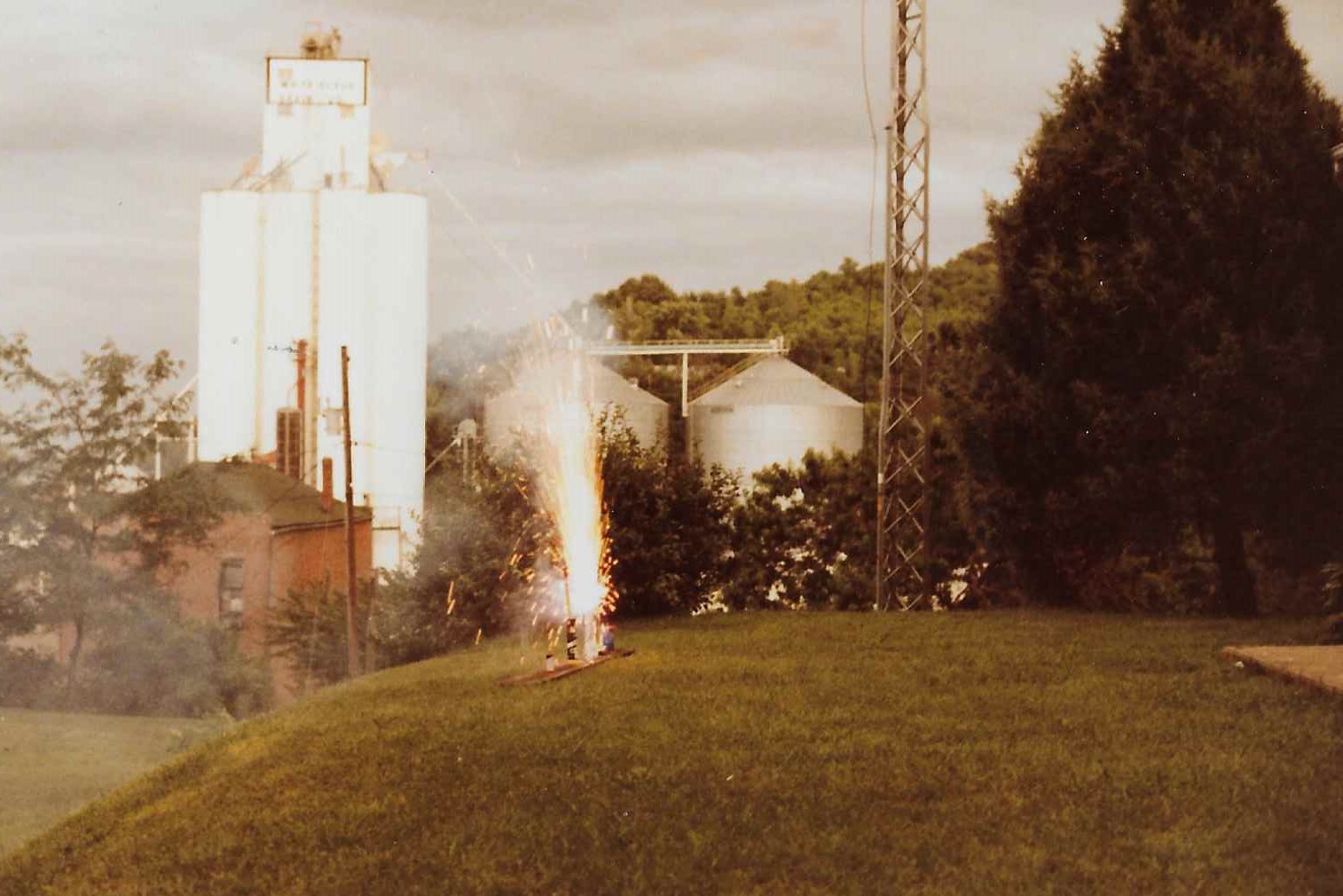

The reason for the inclusion of these few photos in the blog will be explained shortly.
The photo with the Paper Moon reference painted in the background, one with my mom, were my Uncle Robert's attempt to commemorate the exciting time that a movie studio came to town, covered the main street with dirt, and filmed a sequence of Ryan and Tatum's escape from a Sheriff's office. They jump in a car, drive to the river road at the end of town, proceed one way and then the other, and finally escape the clutches of the law. The "Sheriff's office" had actually once been a bank.
The dining table photo with everyone gathered around the lighted birthday cake was in the living room of my Aunt Doris and Uncle Hap. From left to right, sitting is my mother, Anita Breeze (June 2002). Next to her, standing, is my Grandma, Gladys Breeze (1989); behind the other two standing women is my Cousin Jim's wife, Ruth (likely 1990's); standing in front of Ruth is my Aunt Doris Rowe, Jim's mom (May 2003); sitting at the end of the table is my Uncle Hap Rowe, Jim's dad (May 2003); sitting to Hap's left is my Uncle Robert Breeze (2012); sitting on the far right is my Cousin, Jim Rowe. Everyone in the photograph except my Cousin Jim is dead, with the (approximate) date of death in parentheses. Cousin Jim, who is very much alive, still lives in Kansas.
The second picture from the top looks north at the bending Missouri River from the Northern hill above the town. The bottom photograph (with my roommate Gary at the time and myself standing) is of the top of the Southern hill above the town. Uncle Robert owned the hill for years until his death. It passed to his often-estranged son, Ray Breeze, and none of us knows who owns that hill now (Ray attempted to sell off anything and everything he got from his late father before, during and immediately after the funeral). The photo second from the bottom looks across from Doris and Hap's front yard at the town's grain elevator. I have stood on the top on a few occasions over the years, beginning in 1966, and surveyed the town below, from the river end to the closed elementary school at the opposite end.
The photo of my Uncle Robert and mom includes the front porch of the Nuzum house that Robert later owned for a number of years, again until his death. But like most of the historic structures in the town, it became musty and broken down because Robert could not hold back time forever. Again, I have no idea if Cousin Ray (whom none of us knew at all until we briefly met him at Uncle Robert's funeral and did not take to him at all) was able to sell the house or if it's deteriorated well beyond repair. (It is in front of that house where the aged black and white photo was taken in 1921--from a different angle--of four generations of Hook/Nuzum/Breeze women, beginning with Great Great Grandmother Hook and ending with my infant mother in her lap, with Grandma Gladys Breeze and her mother, Great Grandma Nuzum, standing around Great Great Grandmother Hook.)
I currently have not found any photographs of the town's Olive Branch cemetery (though my mother took so many over the years). Grandpa Ray Breeze (Gladys's husband) was buried there in 1954 when he died of a sudden heart attack at the age of 55.
The reason these photographs are included here is because the tenth volume in the series, RAINBOW ARC OF FIRE: OLIVE BRANCH, begins and ends in White Cloud, Kansas. Many of the sites depicted above are featured in the book, including the Olive Branch cemetery. Several of the super-hero characters in the book are staying there for the funeral of Aunt Doris and Uncle Hap in May of 2003.
Sunday, May 12, 2019


Love & Marriage

In 1994, I wrote this passage in Volume One, A Mile-High Saga:
"Greg occasionally wonders if he might ever have the opportunity to lift himself up above his current existence and look at the entire span of his life. Would he, in fact, be viewing a complex maze, one with several, built-in possibilities that he'd never noticed or allowed himself to consider? Or would he see but a single path possible, circuitous perhaps, but puzzling only in its direct simplicity, like some grand connect-the-dots drawing? And what kind of picture would his life's efforts reveal when all of the dots are conjoined?
"Right now, however, to him the image seems incomplete, unfulfilled. Several dots must still be out there, lying unconnected, he believes, waiting for him to find the junction."
This is what I wrote to say to, and about, Mark during the ceremony at our house:
In the first volume in my own series of novels, the main character is lost. He knows where he has been, but he has no idea where he’s going after so much in his previous life was broken. His life also feels incomplete and unfinished, like a connect-the-dots drawing that has not been fully mapped out. That was 1994. On July 16, 2012, I met Mark. It was he who found and connected the remaining dots, completing my life and making me whole for the very first time.
In my favorite series of novels by Armistead Maupin, Tales of the City, the character of Mona created a law: Mona’s Law states that “You can have a hot lover, a hot job and a hot apartment, but you can’t have all three at the same time.” However, meeting Mark--for me--broke Mona’s law. Since Mark came into my life, I have had it all.
In my favorite poem, The Mind Reader by Richard Wilbur, the main character notes that “Some things are truly lost.” When I met Mark, everything was truly found. Together, we have discovered a loving place we call home.
I am now where I belong, with the man I love. At long last I am happy--all because of Mark, the kindest, the most sincere and loving human being I have ever known.
For those of you here today, and those of you who could not be here in person but whose thoughts, we know, are with us on this occasion, you have made this day special, the best day of our lives.
So, it took nearly two decades, twenty years of my life, a momentous Supreme Court decision by one vote, and what only seemed circuitous, to reach the place where I was meant to be, to stand beside the man I was supposed to stand with.
In those Launch Control Facilities under North Dakota where I served with the Air Force, and especially when I was forced to resign from the Air Force Academy when they learned that I was gay, I never could have imagined that I could finally marry the man I loved and wished to spend the rest of my life with. As Mark was aboard a naval destroyer in the North Atlantic, he never could have imagined that he could marry either.
I was born in Florida in 1949, the folks then moved to Georgia for about six months, then on to California. We lived in Victorville, Santa Ana, Whittier and Orange, CA, in the 1950's and very early 1960's. South Gate, CA, in the 1960's. Then I entered the service in 1973 where I was stationed in Minot, ND, then Colorado Springs in 1978. After I was forced to resign, I stayed in the Springs until 1991 when I started working as a contractor for IBM and moved to Denver where I eventually met Mark in 2012.
Where was Mark for part of that time? He was born in Colorado in 1970. His family moved to California but then back to Colorado. He joined the Navy but returned to Colorado when his father's health turned bad. He spent a year in Phoenix, AZ, but came back to Colorado once again. We met online.
After we met, we used to visit my sister and my best friend and his partner in Southern California, and also my aunt in Northern California. Both of us were tired of the increasing traffic and continuing winters of Colorado. California was calling us back and, almost magically, the new house we fell in love with in October of 2015 was still available--with additional incentives--in February of 2016 when we were able to put in an offer to buy it. The neon directional lights of life were telling us where to move and when to make that move. We began to move in three years ago, in early May of 2016. I moved in for good in June of that year. Mark was able to join me in August. The many dots of our lives became fully interconnected, and we were home at last. Together.
Friday, April 19, 2019

Sunday, February 24, 2019
13222 Foxley Drive, Whittier, CA
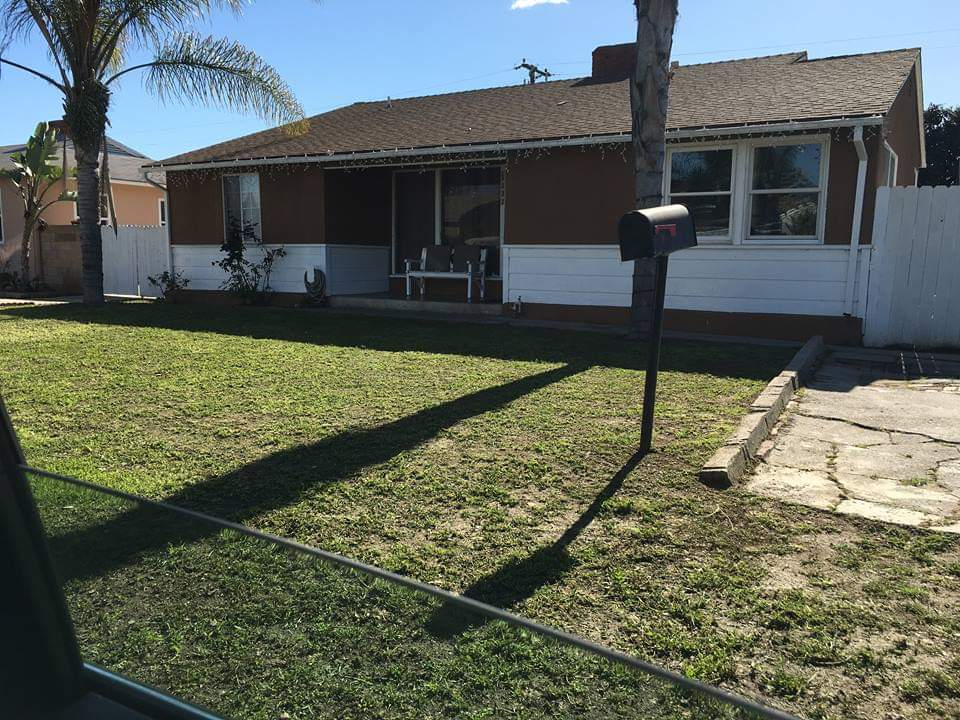

Mark, my sister and I drove to Whittier, CA, to attend a funeral at the grave of my best friend's mom at Rose Hills Cemetery. We decided to stop first by our previous home at 13222 Foxley Drive. Ann revealed that our brand new tract home (in the black & white photo in the center above, with my sister and I standing out front) was built in 1954, shortly after which we moved in. (The house is valued at over $500K.) I still have a vivid memory of my parents closing the door to our bedroom that first night, though leaving it slightly ajar with the hall light on to illuminate the way to the bathroom between our bedroom and our parents' bedroom at the front of the house.
The top photo is of that house today. The bottom color photo is how the house looked in 1987, when Ann and I stopped by and snapped a few pictures since the house was unoccupied and likely being readied for sale. Overall, the house has not changed much in all the intervening years. (I am not certain why the current owners have a fence that blocks passage to the garage in back.)
Our house at 1915 South Broadway in Santa Ana, CA, did not quite seem like home because we were both too young to understand much. But Foxley was where we went to kindergarten and elementary school until the summer of 1959, when we moved to an apartment complex in Orange, CA, prior to our father marrying the wicked step mother, Willene.
For those few years from 1954 until 1959, the house on Foxley Drive was home. Not only was it where we first attended public school, it was also where we celebrated several Christmases and Easters and Halloweens. Foxley is a dead end street, so the block was rather insular. We had friends our own ages up and down the street. Most parents parked their one car in the driveway or the garage, so the street was mostly clear to ride one's bike without much danger. The neighborhood male parents were all WWII veterans who had likely moved into their first new homes and created spaces for their families to thrive. The Tiptons lived across the street, with a daughter my age and a son a year younger than Ann; the Hofeldts lived next door with one daughter a year older than I, another daughter Ann's age, and a son, Donnie, who was several years younger.
Our house at 1915 South Broadway in Santa Ana, CA, did not quite seem like home because we were both too young to understand much. But Foxley was where we went to kindergarten and elementary school until the summer of 1959, when we moved to an apartment complex in Orange, CA, prior to our father marrying the wicked step mother, Willene.
For those few years from 1954 until 1959, the house on Foxley Drive was home. Not only was it where we first attended public school, it was also where we celebrated several Christmases and Easters and Halloweens. Foxley is a dead end street, so the block was rather insular. We had friends our own ages up and down the street. Most parents parked their one car in the driveway or the garage, so the street was mostly clear to ride one's bike without much danger. The neighborhood male parents were all WWII veterans who had likely moved into their first new homes and created spaces for their families to thrive. The Tiptons lived across the street, with a daughter my age and a son a year younger than Ann; the Hofeldts lived next door with one daughter a year older than I, another daughter Ann's age, and a son, Donnie, who was several years younger.
So many black & white photographs attest to the birthday parties and a Halloween party and Christmas gatherings. This was the 1950's, a time when many Americans still living look back upon fondly. The late 1940's were still a time of disruptions, both political and cultural. Industries took precious time to convert back to civilian manufacturing. Towns and cities were still recovering from the Great Depression and WWII when infrastructures aged and frayed. Many GI's went to college or tried to find jobs or careers after they returned from the war. The 1950's seemed to be the true modern flowering of Mid-Century Modern. New cars with new designs and features rolled off the assembly lines each fall and appeared in showrooms and on the streets, fascinating the boys and their fathers. More modern aircraft flew overhead on their path to Los Angeles International Airport.
Television and toys were gearing up to capture the attention and the wallets of our generation. I still remember the evening my sister came home from visiting a girlfriend to tell us that a new Disney program, The Mickey Mouse Club, was about to air. Mom turned on the TV in the den (it was not in the living room), and we watched from that afternoon forward.
Our parents seemed happy and in love. They made us feel safe and secure. But that was not to last. Mom, I am told, became bored with a husband whom she had married in 1947 who was a Captain in the Air Force. But when a new war began in Korea in 1950, he did not want to serve where he might once again become a prisoner of war as he had been in Germany when his bomber was going to crash and the crew bailed out. He got out of the Air Force at some point in the early 1950's, found a job at a Fuller Paint store in Whittier, and the family soon moved from Santa Ana to Foxley Drive.
The marriage began to come apart before the decade ended. I remember dad once asking me if I were to choose, whom did I wish to live with? Him or our mother? I, of course, replied that I wanted to live with both of them. He insisted that that was not going to be possible. Ann remembers that when he asked her what she wanted for Christmas at The Quad, the nearby mall in Whittier, and she said, "A Betsy Wetsy doll," he simply grabbed one off the shelf and bought for her, oblivious to her protestations that she wanted Santa Claus to bring it for Christmas. We had a series of housekeepers after mom moved out, one in particular was old and cruel and did not spare the rod. Then our Grandmother lived with us for a time and helped to raise us, though she was not the best person to deal with us grandkids because she could be physically abusive. Life on Foxley had turned unhappy.
Our parents seemed happy and in love. They made us feel safe and secure. But that was not to last. Mom, I am told, became bored with a husband whom she had married in 1947 who was a Captain in the Air Force. But when a new war began in Korea in 1950, he did not want to serve where he might once again become a prisoner of war as he had been in Germany when his bomber was going to crash and the crew bailed out. He got out of the Air Force at some point in the early 1950's, found a job at a Fuller Paint store in Whittier, and the family soon moved from Santa Ana to Foxley Drive.
The marriage began to come apart before the decade ended. I remember dad once asking me if I were to choose, whom did I wish to live with? Him or our mother? I, of course, replied that I wanted to live with both of them. He insisted that that was not going to be possible. Ann remembers that when he asked her what she wanted for Christmas at The Quad, the nearby mall in Whittier, and she said, "A Betsy Wetsy doll," he simply grabbed one off the shelf and bought for her, oblivious to her protestations that she wanted Santa Claus to bring it for Christmas. We had a series of housekeepers after mom moved out, one in particular was old and cruel and did not spare the rod. Then our Grandmother lived with us for a time and helped to raise us, though she was not the best person to deal with us grandkids because she could be physically abusive. Life on Foxley had turned unhappy.
I remember in the middle of one Christmas Eve night before it all turned unpleasant, when I walked to the bathroom, I decided to slide back the pocket door to the living room. In the light from the hall, and under the tree by the picture window, were many presents that attested to the fact that not only had Santa visited, he had been quite generous that night to us two kids.
It was that sense of home and family that has scented my dreams of having the perfect familial life once again. I almost approached that experience when I lived at 6555 Palmer Park Blvd in Colorado Springs, CO. But that was after I was forced to resign from the Air Force; and while I had a couple of roommates over the years, I never had a partner to complete the picture of a happy home.
I suspect that is why all seems well, and even near perfect, here, living in California once again after all those years of living in North Dakota with the Air Force and then Colorado. The hopes and dreams have come true, even if it took as long as these advanced years to actually be fulfilled.
Sunday, January 27, 2019
Another night of retro dreams
My best friend's mother has died of the same blood-flooding-the-brain event. So similar to what my Aunt Jean experienced when she died in 2017. They were both 93. Also found face-down on the bathroom floor, each was effectively dead before her body struck the floor. Jean was found after she had fully died. My friend's mom was taken to the hospital, brain dead, but kept breathing by a tube until her daughter could join her two brothers and, essentially, pull the plug with all of them present.
For Mike and me, all of the aunts and uncles and grandparents and parents are now gone. That era has come to a final close. For us now, we and our few siblings, no matter how many years that may take, are next in line.
I was reminded of this sort of thing when an offensive lineman for the undefeated Miami Dolphins of 1972, Bob Kuechenberg, died the other day at age 71. I saw that team live in the LA Coliseum for Super Bowl VII in 1973 (back when a normal person could acquire--and afford--a Super Bowl ticket). Privately, those football players may notice as the years pass that more and more of their teammates have died. Eventually, the number of players on that team who are still alive are outnumbered by those who have passed. In time, all will have passed.
The dream I had was finding a well-worn Christmas wreath from decorations used in the Kaman plant where I worked from the Spring of 1980 through mid-1988, when I lived in Colorado Springs after I was forced to resign from the Air Force in 1979.
I wake up from such dreams and my mind slips me back to those years of the 1980's when I wondered if I would ever get my life back into some kind of order, some kind of harmony, after the disruption of losing one's first, best career. Those years were ones of recovery not renewal. I didn't have a purpose. I didn't have a permanent place. The world I tried to create felt unfulfilled.
I used to write that I had finally gotten an invitation to the party (being out and gay), only to find that the party was over before any of us realized (AIDS). The newspaper articles began to detail the crisis. The TIME magazine cover article summarized what was known. The movies: PARTING GLANCES, LONGTIME COMPANION, gave faces to the disease. Randy Shilts's book culminated in an attempt to make it all history. (I remember a few of us joking that it was the popcorn at The Foxhole bar. Some suspected but nobody knew for sure how the disease might be transmitted.)
I spent those eight transition years working for two different groups at Kaman Corporation on Garden of the Gods Road in Colorado Springs. First, it was the Displacement Measuring Devices group (where I worked with Shirley Overholser, Rich Hostak, Greg--whose last name escapes me--and the much older inventor of the device that they built and tested and I wrote about, whose entire name I cannot now recall) and then the Radiation Monitoring Group. For that second team, I had many coworkers with whom I worked tangentially. I had my solo office in the basement with no one else in that enclosed space but me. When I had little technical writing to do, or parts to order (I was also given the supply job, to order those parts used to make the radiation detection skids that went into nuclear power plants), I read books to assist my teaching college classes in the evenings at the military bases around Colorado Springs for Pikes Peak Community College, at Fort Carson and Peterson Air Force Base.
At Kaman, we got the Christmas week off each year. So while the pay was generally low--hence my continuing to teach sometimes five nights a week and all day Saturday--that week off between Christmas and New Year's was a treat. And then it all came to an end when the Radiation Monitoring division was sold to a private investor. I worked for that company for a few months before they packed up and were moving to South Carolina, where the new owner was from. I didn't go but instead enrolled in a teacher's certification program at the University of Colorado at Colorado Springs (UCCS). I visited the campus one fine afternoon, contemplating what I ought to do. The next morning, my horoscope in the local Gazette Telegraph newspaper read, "You should consider going back to school to get your teaching credential." Signs from the universe rarely get that specific.
I spent the next 14 months attending classes and acquiring that credential. After graduation, I went on at least three interviews at middle and high schools in the area, the most significant one being Air Academy High School, almost right back where I had been jettisoned 10 years earlier, teaching some of the same students that I had taught at the nearby middle school. It was a natural and fitting transition.
But I wasn't hired.
I still believe that it was because the head of the English Department at the high school was male; but all of the other English teachers were female. I think he vetoed me (and I also heard from someone I knew in that department who confirmed my judgment).
I finally got a job the next year on a technical writing project for Capitol Federal Savings and Loan in the Tech Center of Denver, making more money per hour than I had ever made at Kaman. I still taught my evening classes in Colorado Springs, forced to drive from the south of Denver to the south of Colorado Springs at Fort Carson. I kept my house, but no full-time job came through as the Cap Fed job folded in June of 1990, after I had started in March of that year. (I had gotten that windfall job because my former roomie, Dino, was entering a building in Denver as a former co-renter of an old house cut into tiny apartments in Denver was exiting. Don and Dino chatted for a time, and Dino informed him that he knew a technical writer in need of a job. Don had just been hired for a technical writing project, a job that required more writers.)
In the early Spring of 1991, as I was still looking for a job, a woman with whom I had worked at Cap Fed, got a job at IBM. They also needed more writers on that project, and she contacted me. (As most contractors know, if you place a fellow worker in a project for your contracting firm, you get a $1,000 or more bonus if they remain on the job for a specific length of time.) Nancy got the bonus and she and I remained on the Joint Application Development (JAD) project for slightly more than a year. We got moved over to the Federal Systems Division for a few months after the JAD project ended. I also continued to teach at Fort Carson two nights a week while I rented out my house in Colorado Springs to a friend and his partner while I continued to live in an apartment complex in Denver.
While working at those two projects for IBM, I also applied for a full-time English teaching job at Denver Community College. I ought to have been a natural fit, having taught for Pikes Peak Community College for more than a decade, as well as at the Air Force Academy. Somewhere between 15-20 of us sat in a classroom waiting to hear from the head of the department. Most of those sitting around me were younger women. The head of the department was a man. We were told that five of us would be selected as finalists to be evaluated in a mock classroom situation. I was not even selected as a finalist.
Eventually, even the Federal Systems project ended and I was out of work once more. During those 4-5 weeks of unemployment, two job prospects appeared that would have rerouted my life in an almost full circle.
The first would have taken me back to Colorado Springs and Garden of the Gods Road. Hewlett Packard, just across a large field and down the block from Kaman, needed a tech writer. I interviewed. My only competition was a younger woman (just like the first time I interviewed at Kaman and was not hired) who was also not a veteran and was far less experienced as a technical writer than I.
But I was not hired.
I could have moved back into my house at 6555 Palmer Park Blvd. and returned to living the life I had lived while working at Kaman. But that was not to be.
The second--even more significant job prospect--I read about on the wall of the unemployment office in Denver. The Air Force Academy was being mandated to hire a certain number of civilian instructors. The English Department was going to hire one civilian instructor. I ought to have been a natural fit, having taught at the Air Force Academy in the English Department, as well as my Pikes Peak Community College experience, in addition to more than a decade as a technical writer, and a former Air Force officer. A Master's Degree was all that was required. I learned that just over 100 people applied.
I was not selected.
Even during the 1980's, Mike kept telling me that California was building more community colleges, they needed experienced teachers, and that I should apply so I could move back to that state where I had left for good in 1973. I resisted because I loved Colorado, I had my house in the Springs, and I did not want to return at that point.
Eventually, after that five-week break of unemployment, I heard once more from Nancy that she had gotten hired again at IBM, this time by the Sales Manual team and they needed more technical writers. I was hired. She got another bonus check. Nearly 28 years later, I am still at that job. But there are a couple of caveats:
Had I gotten hired full-time by Pikes Peak College, I would have been able to retire a few years ago with a full retirement of working over 25 years (just before I left Colorado Springs, I was in the running for a full-time job in the English Department; but the department rigged the requirements so that I came in second--this time the faculty was all female and the one who met the criteria they applied was also female; and they knew her because she had taught part-time at the main campus while I was next door at the Fort--they did not bother to get to know me. They also did not take into consideration that I had taught many more courses in English, communications, history, humanities and Literature for PPCC, nor did they consider that I had taught 9 English classes at the Air Force Academy and another for Chapman College. The woman I was competing against had taught a couple more English classes for PPCC at the main campus; and that was how they selected her and not me. A rigged criteria if ever I saw one.)
Had I gotten hired full-time by Denver Community College, the same comfortable retirement could have occurred after 25 years of teaching there. As it is, I only have social security to live on were my IBM job to finally end.
But had my path not diverged in the woods, I would not have been able to violate "Mona's law": "In one of Armistead Maupin's Tales in the City books, Mona expounds Mona's Law, 'You can have a hot lover, a hot job and a hot apartment, but you can't have all three at the same time....'" (I would also add hot car to Mona's list.)
Regardless of how, at the time, I wanted to teach back at the Academy, or at PPCC, or DCC, that's not what happened. Regardless of the sexism (both male and female) over the years that likely contributed to my not staying in Colorado Springs or returning to Colorado Springs, I now have a great house, a nice job, a hot lover, and a nice car. And I am out of the snow and cold of Colorado.
Regardless of what we think we want through the years, Fate (or whatever you want to call it) often knows best.
For Mike and me, all of the aunts and uncles and grandparents and parents are now gone. That era has come to a final close. For us now, we and our few siblings, no matter how many years that may take, are next in line.
I was reminded of this sort of thing when an offensive lineman for the undefeated Miami Dolphins of 1972, Bob Kuechenberg, died the other day at age 71. I saw that team live in the LA Coliseum for Super Bowl VII in 1973 (back when a normal person could acquire--and afford--a Super Bowl ticket). Privately, those football players may notice as the years pass that more and more of their teammates have died. Eventually, the number of players on that team who are still alive are outnumbered by those who have passed. In time, all will have passed.
The dream I had was finding a well-worn Christmas wreath from decorations used in the Kaman plant where I worked from the Spring of 1980 through mid-1988, when I lived in Colorado Springs after I was forced to resign from the Air Force in 1979.
I wake up from such dreams and my mind slips me back to those years of the 1980's when I wondered if I would ever get my life back into some kind of order, some kind of harmony, after the disruption of losing one's first, best career. Those years were ones of recovery not renewal. I didn't have a purpose. I didn't have a permanent place. The world I tried to create felt unfulfilled.
I used to write that I had finally gotten an invitation to the party (being out and gay), only to find that the party was over before any of us realized (AIDS). The newspaper articles began to detail the crisis. The TIME magazine cover article summarized what was known. The movies: PARTING GLANCES, LONGTIME COMPANION, gave faces to the disease. Randy Shilts's book culminated in an attempt to make it all history. (I remember a few of us joking that it was the popcorn at The Foxhole bar. Some suspected but nobody knew for sure how the disease might be transmitted.)
I spent those eight transition years working for two different groups at Kaman Corporation on Garden of the Gods Road in Colorado Springs. First, it was the Displacement Measuring Devices group (where I worked with Shirley Overholser, Rich Hostak, Greg--whose last name escapes me--and the much older inventor of the device that they built and tested and I wrote about, whose entire name I cannot now recall) and then the Radiation Monitoring Group. For that second team, I had many coworkers with whom I worked tangentially. I had my solo office in the basement with no one else in that enclosed space but me. When I had little technical writing to do, or parts to order (I was also given the supply job, to order those parts used to make the radiation detection skids that went into nuclear power plants), I read books to assist my teaching college classes in the evenings at the military bases around Colorado Springs for Pikes Peak Community College, at Fort Carson and Peterson Air Force Base.
At Kaman, we got the Christmas week off each year. So while the pay was generally low--hence my continuing to teach sometimes five nights a week and all day Saturday--that week off between Christmas and New Year's was a treat. And then it all came to an end when the Radiation Monitoring division was sold to a private investor. I worked for that company for a few months before they packed up and were moving to South Carolina, where the new owner was from. I didn't go but instead enrolled in a teacher's certification program at the University of Colorado at Colorado Springs (UCCS). I visited the campus one fine afternoon, contemplating what I ought to do. The next morning, my horoscope in the local Gazette Telegraph newspaper read, "You should consider going back to school to get your teaching credential." Signs from the universe rarely get that specific.
I spent the next 14 months attending classes and acquiring that credential. After graduation, I went on at least three interviews at middle and high schools in the area, the most significant one being Air Academy High School, almost right back where I had been jettisoned 10 years earlier, teaching some of the same students that I had taught at the nearby middle school. It was a natural and fitting transition.
But I wasn't hired.
I still believe that it was because the head of the English Department at the high school was male; but all of the other English teachers were female. I think he vetoed me (and I also heard from someone I knew in that department who confirmed my judgment).
I finally got a job the next year on a technical writing project for Capitol Federal Savings and Loan in the Tech Center of Denver, making more money per hour than I had ever made at Kaman. I still taught my evening classes in Colorado Springs, forced to drive from the south of Denver to the south of Colorado Springs at Fort Carson. I kept my house, but no full-time job came through as the Cap Fed job folded in June of 1990, after I had started in March of that year. (I had gotten that windfall job because my former roomie, Dino, was entering a building in Denver as a former co-renter of an old house cut into tiny apartments in Denver was exiting. Don and Dino chatted for a time, and Dino informed him that he knew a technical writer in need of a job. Don had just been hired for a technical writing project, a job that required more writers.)
In the early Spring of 1991, as I was still looking for a job, a woman with whom I had worked at Cap Fed, got a job at IBM. They also needed more writers on that project, and she contacted me. (As most contractors know, if you place a fellow worker in a project for your contracting firm, you get a $1,000 or more bonus if they remain on the job for a specific length of time.) Nancy got the bonus and she and I remained on the Joint Application Development (JAD) project for slightly more than a year. We got moved over to the Federal Systems Division for a few months after the JAD project ended. I also continued to teach at Fort Carson two nights a week while I rented out my house in Colorado Springs to a friend and his partner while I continued to live in an apartment complex in Denver.
While working at those two projects for IBM, I also applied for a full-time English teaching job at Denver Community College. I ought to have been a natural fit, having taught for Pikes Peak Community College for more than a decade, as well as at the Air Force Academy. Somewhere between 15-20 of us sat in a classroom waiting to hear from the head of the department. Most of those sitting around me were younger women. The head of the department was a man. We were told that five of us would be selected as finalists to be evaluated in a mock classroom situation. I was not even selected as a finalist.
Eventually, even the Federal Systems project ended and I was out of work once more. During those 4-5 weeks of unemployment, two job prospects appeared that would have rerouted my life in an almost full circle.
The first would have taken me back to Colorado Springs and Garden of the Gods Road. Hewlett Packard, just across a large field and down the block from Kaman, needed a tech writer. I interviewed. My only competition was a younger woman (just like the first time I interviewed at Kaman and was not hired) who was also not a veteran and was far less experienced as a technical writer than I.
But I was not hired.
I could have moved back into my house at 6555 Palmer Park Blvd. and returned to living the life I had lived while working at Kaman. But that was not to be.
The second--even more significant job prospect--I read about on the wall of the unemployment office in Denver. The Air Force Academy was being mandated to hire a certain number of civilian instructors. The English Department was going to hire one civilian instructor. I ought to have been a natural fit, having taught at the Air Force Academy in the English Department, as well as my Pikes Peak Community College experience, in addition to more than a decade as a technical writer, and a former Air Force officer. A Master's Degree was all that was required. I learned that just over 100 people applied.
I was not selected.
Even during the 1980's, Mike kept telling me that California was building more community colleges, they needed experienced teachers, and that I should apply so I could move back to that state where I had left for good in 1973. I resisted because I loved Colorado, I had my house in the Springs, and I did not want to return at that point.
Eventually, after that five-week break of unemployment, I heard once more from Nancy that she had gotten hired again at IBM, this time by the Sales Manual team and they needed more technical writers. I was hired. She got another bonus check. Nearly 28 years later, I am still at that job. But there are a couple of caveats:
Had I gotten hired full-time by Pikes Peak College, I would have been able to retire a few years ago with a full retirement of working over 25 years (just before I left Colorado Springs, I was in the running for a full-time job in the English Department; but the department rigged the requirements so that I came in second--this time the faculty was all female and the one who met the criteria they applied was also female; and they knew her because she had taught part-time at the main campus while I was next door at the Fort--they did not bother to get to know me. They also did not take into consideration that I had taught many more courses in English, communications, history, humanities and Literature for PPCC, nor did they consider that I had taught 9 English classes at the Air Force Academy and another for Chapman College. The woman I was competing against had taught a couple more English classes for PPCC at the main campus; and that was how they selected her and not me. A rigged criteria if ever I saw one.)
Had I gotten hired full-time by Denver Community College, the same comfortable retirement could have occurred after 25 years of teaching there. As it is, I only have social security to live on were my IBM job to finally end.
But had my path not diverged in the woods, I would not have been able to violate "Mona's law": "In one of Armistead Maupin's Tales in the City books, Mona expounds Mona's Law, 'You can have a hot lover, a hot job and a hot apartment, but you can't have all three at the same time....'" (I would also add hot car to Mona's list.)
Regardless of how, at the time, I wanted to teach back at the Academy, or at PPCC, or DCC, that's not what happened. Regardless of the sexism (both male and female) over the years that likely contributed to my not staying in Colorado Springs or returning to Colorado Springs, I now have a great house, a nice job, a hot lover, and a nice car. And I am out of the snow and cold of Colorado.
Regardless of what we think we want through the years, Fate (or whatever you want to call it) often knows best.
Thursday, August 30, 2018


Monday, July 23, 2018
Brief reviews of several volumes in the series
RAINBOW ARC OF FIRE: A MILE-HIGH SAGA:
"...a creative and uplifting tale of a Denver gay superhero...."
-Susan Ramsey
OUT FRONT COLORADO
RAINBOW ARC OF FIRE: AUTUMN SAGA:
"...refreshingly light hearted. A welcome departure from most contemporary gay fiction...."
-Martin Garnar
Dayton Memorial Library
Regis University
RAINBOW ARC OF FIRE: SOULS WITHIN STONE:
"...Brought a tear to this old cynic's eye."
-Will Morgan
30th Century Comics
London, UK
RAINBOW ARC OF FIRE: WORLDS BENEATH US:
"...the whole is eminently satisfactory."
-Will Morgan
30th Century Comics
London, UK
RAINBOW ARC OF FIRE: SLIGHT OF MIND:
"My favourite of the series...."
-Will Morgan
30th Century Comics
London, UK
RAINBOW ARC OF FIRE: HARMONY OF SPHERES:
"...wonderfully entertaining...."
-J.A. Fludd
Author of the Environauts
RAINBOW ARC OF FIRE: WHO HAS DOMINION?:
"...the only questions that really matter in the case of series such as this are, "Do we want to see more?", "Will we fork out money for future volumes?" and the answer to those key questions is an emphatic 'yes, please.'."
-Will Morgan
RAINBOW ARC OF FIRE: A HOUSE DIVIDED:
"The good thing about the book is that Sanchez has no illusions that RAINBOW is anything but fun, a sort of mega-comic book. Sanchez's heart is in the right place. His views on disunity in the community and injustice strike a noble chord."
-The Lambda Book Report
"...This, obviously, is the most comic-book-like of the RAoF books (so far)….."
-J.A. Fludd
