


It appears that no Comic Cons remaining this year will be held. We had a hotel room at the Hilton next to the Anaheim Convention Center where WonderCon is held each year. But we were forced to cancel when we learned that WonderCon was postponed indefinitely. I suppose there is a chance for the fall but unlikely.
Nothing has happened yet, but ComicCon San Diego will also be cancelled or postponed. So I won't be able to give away or sell books this year at all.
I hope everyone stays safe. Mark and I are hunkered down in the house and only go outside to walk to the mailbox or drive somewhere to get groceries or food once or twice a week. We hope later this morning that Ralph's will have toilet paper and bottled water and food.
Sunday, March 22, 2020


Sunday, January 12, 2020
Cats in the Rainbow Arc of Fire series


Schnozz was something else. Smart and sassy, she ruled the house at 6555 Palmer Park Blvd in Colorado Springs before I moved to Denver. The drive to Denver when I moved, taking her to the small apartment on Humboldt St. in Denver, was traumatic for her. The 1-bedroom apartment was so much less roomy than the 3-bedroom, 4-level house. And when temporary roommate and not much of a BF Frank Massey brought to the apartment Sneezer from the Dumb Friends League, Schnozz was further distressed. The two did not get along well but finally tolerated one another.
When I sent Frank packing back to Virginia but kept Sneezer, and we all moved to another small apartment in another building in the Humboldt apartment complex, relations were only marginally better. They eased a bit when the three of us moved to a 2-bedroom apartment two doors down from the second small 1-bedroom, and each cat had his or her places to pass the time. Sneezer took the spare bedroom and would sit atop a carpeted cat pedestal and watch the passersby on the sidewalk below. Schnozz ruled the bedroom and the carpeted pedestal there.
It was the death of Schnozz that formed a centerpiece in the green book, Volume 4, Worlds Beneath Us.
Speaking of Sneezer:
It was the death of Schnozz that formed a centerpiece in the green book, Volume 4, Worlds Beneath Us.
Speaking of Sneezer:


He would always sound so mournful in the car on the way to the vet's office to get his regular checkups and shots. He loved living in the condo and hated to leave. But this morning he was silent. I had wrapped him up in a favorite towel and he sat on the passenger seat, looking tired but determined. After he drifted away on the table in the vet's office, I could not contain myself and cried like a baby all the way home and for hours after. As with Schnozz before, I had him cremated and have his ashes still.
After Schnozz was gone, my friend Dino and his partner Larry were shedding their three cats in favor of dogs. They gave me Miranda, the eldest. Sneezer took quite some time to take to her in the 2-bedroom apartment on Humboldt after she arrived. Miranda, like Schnozz, only lived to be about 12-13 years. She had moved along with Sneezer and me to the condo on Franklin St. At some point, she developed terrible tumors on the back of her neck from the rabies shots from the vet. She then endured three separate surgeries, six months apart, to remove successive tumors as they aggressively developed, one set after another. They would not stop. I finally had to wrap a sock around her neck to keep her from scratching at the wound that the doctor no longer could find enough skin to close at the end of the third surgery. Again, as with Schnozz, I had to contact the vet for a dreaded house call. I let Miranda sit peacefully in the front garden amidst the foliage until the vet arrived in the early afternoon. She left peacefully on that same living room couch pictured above. Her death was mentioned in Olive Branch, the last volume in the series.
Strangely, a few nights later I awoke to a familiar sound from the kitchen. I looked up and Sneezer was staring in the direction of the kitchen, around the corner from the bedroom. A night light from the kitchen counter had put his curious head and pointed ears in silhouette. We were both listening momentarily to the sound of Miranda, again scratching at the taped sock around her neck. Of course, even though I checked the kitchen counter where she used to lay before she died, feeling the welcome heat from the back of the fridge, she was not there. Take this haunting story as you like. I have never seen a ghost before, but both Sneezer and I heard something from the kitchen that night that sounded remarkably like the sound of Miranda scratching.
Strangely, a few nights later I awoke to a familiar sound from the kitchen. I looked up and Sneezer was staring in the direction of the kitchen, around the corner from the bedroom. A night light from the kitchen counter had put his curious head and pointed ears in silhouette. We were both listening momentarily to the sound of Miranda, again scratching at the taped sock around her neck. Of course, even though I checked the kitchen counter where she used to lay before she died, feeling the welcome heat from the back of the fridge, she was not there. Take this haunting story as you like. I have never seen a ghost before, but both Sneezer and I heard something from the kitchen that night that sounded remarkably like the sound of Miranda scratching.
This was Calico Miranda in the Franklin St. condo before she started to develop the tumors. She loved to sit atop the cable box for warmth:


After Miranda had gone, the sister of a woman I worked with had, with a coworker at Coors Brewery, rescued a few-weeks-old kitten at the site. He needed a home. Linda asked me and I said I would take him. I named him Pudge because, when he would scrunch himself up, front to back, he'd look rather pudgy. Again, Sneezer was not too keen on a new roommate. But Pudge was smart and determined, even as a kitten. Just as I was telling a friend on the phone that I did not see what I was going to do to help them get along, I looked down and Sneezer and Pudge were eating their breakfast together off the same small plate. Pudge had figured out how to push open the folding bathroom door and was eating contentedly next to the much bigger Sneezer.
Pudge is with me still, as is Tabby, who replaced Sneezer. Tabby was discovered going door to door in the sister's boyfriend's neighborhood in Denver, getting food wherever she could beg it. She may have been owned by a family across the street from Linda's sister's boyfriend. But when he saw Tabby sitting by a couple of the family members on the sidewalk and he asked if they owned her, they offered, "Yes, do you want her?" One morning he catnapped her, put her in a cat carrier, took her to his girlfriend's house, and I picked her up there, where I had gathered up Pudge a couple of years earlier. As with Pudge, I took her to the vet and got her fixed (that family had neglected to do what they were legally required to do regarding spaying a pet). The vet told me that, even at six months old, she was fully ready to have kittens of her own.
Pudge and Tabby made their way on Mark's and my first long drive between Denver and Indio. We drove non-stop to limit their suffering, only getting gas occasionally for the van we were using to transport the cats and our two TVs.
After such a small condo, only a bit more than 900 square feet, the 2100-square-foot house must have seemed enormous. I first found them curled up together in one of the litter boxes. They seemed terrified of their new surroundings. By our final night before Mark and I had to fly back to Denver, they'd entirely disappeared. Numerous times I searched the whole house and the neighborhood (though how both had gotten out of doors was highly improbable). We eventually had to leave for the airport, but I told my best friend and my sister, who would feed and look after them while we were gone, to keep laying out food and checking the litter boxes. They confirmed that food was being eaten and litter boxes were being used, but no cats could be found anywhere in the house.
It was Mike a few days later who finally realized that they might have squeezed under the narrow opening in the back of a long, low chest in our new bedroom and would remain there until food had been left out and the unwanted strangers had departed the house. He tilted the cabinet forward and found two surprised cats staring up at him. They took off for the moment, but we were relieved after I got his call.
Here are Tabby (top) and Pudge in 2007 in the condo in Denver:


Friday, January 3, 2020
Category Six Books


At this point, James Dovali had purchased the store from the original owner not long after the move to the South Broadway location. After my series began to be written, naturally the first owner and James were kind enough to carry the several volumes as they appeared. And, even more fortunately, I was able to hold several book signings over the years, especially before Christmas when everyone was doing his holiday shopping. (I say "his" because while Category Six carried current lesbian titles, they rarely sold because the store had few lesbian customers. Eventually, a lesbian bookstore would open on 13th street, east of Josephine, making the segregation complete. When I approached the manager of that store to carry my novels since there were prominent lesbian characters, I was flatly dismissed.)
The 1980's were the heyday of gay bookstores around the country. That would continue into the 1990's. But before that decade was over, the Internet was beginning to make serious inroads into sales. James knew that the closing of the store he loved so much was going to occur, he just was not exactly sure when he would be forced to close it. I knew that the closing would likely be the doom of my series, as well. Independent book stores of all varieties were also closing. As my series hit its stride, all over the country gay book stores were shutting down. Stores that had been in existence for years were forced to face the reality of amazon.com especially and self-terminate. Whereas I had once been able to send notices of the first volume to so many stores around the nation, I was getting more and more returns of notices sent to smaller towns and cities, and then bigger ones as well, when the subsequent novels were published. My list of potential stores to carry my books was dwindling fast.
At Category Six Books, I had sold between 300 and 400 copies of all volumes in the series. James was always very helpful; and the sales helped him, as well. The seventh volume in the series even has the main characters visit Category Six Books as part of the plot.
I used to visit the store most Saturday mornings after he'd opened the doors. Since business was sometimes slow at that hour, we'd chat about everything: music, book sales, whatever. He admitted on several occasions that it was the porn section in back that was keeping the store afloat when regular sales began to slow. Even as we would chat, a few customers would enter, stride through the interior of the store, and take up station in the very back, partitioned to keep the porn magazines separate from the rest of the store. But, of course, as the Internet broadened, one could get his active porn there rather than just stare at a motionless photo on a page.
Although he warned them not to, a gay couple badly wanted to own the store. Despite repeated warnings, they finally bought him out for a tidy sum they really could ill afford, changed so much about the interior of the store that it looked like someone's grandmother's living room, and wasted money on such unnecessary purchases as a new cash register, among other items. The sale of my books cratered--they were not at all as helpful as James had been. Old customers who had hung on also seemed to disappear (though many had already abandoned buying books there).
The other issue was that the original owner had believed that the South Broadway area was going to bloom as a new gay mecca in Denver. And it appeared at first that it would. There was a Heaven Sent Me novelty store a block or so away. A pan-sexual café was a few doors down. But even some of those places eventually died, and it really never became that gay area everyone would want to visit. The rent at the original location was going up prohibitively, so he had to move somewhere; and this had seemed as good as any. But the locale became not an oasis but a desert that was drying up after the relocation.
Unfortunately, for the newest, and last, owners, the landlord was redoing the front of the building a year or so later, which would have further discouraged the few remaining customers from entering the front door. They simply sold out everything at a massive discount. I got a call to pick up my remaining books that had always been on the shelves on consignment anyway. They slipped away in the night and that was the end of a bookstore that had been around for likely more than 20 years.
A few months before they closed, they held a memorial for James Dovali. He had drifted from one improbable occupation to another after he'd sold the store, but none seemed to suit him. I had entirely lost touch. Before he moved on, I had given him a spare carpeted cat tower since he'd acquired a stray he'd named Slim Shady. This energetic cat that used to live at the bookstore, as well as the carpeted tower, were acquired by an older couple who had known James. Rootless now with the store he had cherished gone for six months, James died of AIDS. I saved his obituary from the newspaper for several years, but it may have gotten lost in my move to California. I liked him, and I missed our morning conversations at the store. He'd done what he could to push the sales of Rainbow Arc of Fire, and I appreciated that very much.
By the way, the title of the bookstore referred, if I am remembering correctly, to a category of books that were deemed gay, as well as controversial. It was not a positive description but almost a clinical definition. The first owner used to say that they probably should have changed the name at some point during its heyday but never got around to it. Most customers had no idea what the name referred to even when they knew of the store itself.
Besides the gay bookstores closing, gay magazines and newspapers were also ending as the 1990's came to a close. Gay novels and other titles were also either going mainstream or diminishing in number as major publishing houses were no longer making the kind of money they'd earned in the late 80's and early 90's promoting gay titles. That's why my books did not get picked up by St. Martin's press, and I was eventually forced to self-publish. And, of course, so many who likely supported gay stores and books and magazines and other gay-friendly businesses were dying off, of old age and AIDS, until the life-saving drug cocktails became available from 1995 on.
Besides the gay bookstores closing, gay magazines and newspapers were also ending as the 1990's came to a close. Gay novels and other titles were also either going mainstream or diminishing in number as major publishing houses were no longer making the kind of money they'd earned in the late 80's and early 90's promoting gay titles. That's why my books did not get picked up by St. Martin's press, and I was eventually forced to self-publish. And, of course, so many who likely supported gay stores and books and magazines and other gay-friendly businesses were dying off, of old age and AIDS, until the life-saving drug cocktails became available from 1995 on.
But while the store still endured, as you can see by the Top Ten book shelf I photographed above, one week my first novel was #2 to Maupin's The Night Listener. Especially after a signing, I might have two or three books on the Top Ten shelf. But now that is becoming so many years ago.
James and I would put out a coffee urn filled with hot cider, cloves and cinnamon, which gave the store a warm aroma, we'd lay out Christmas cookies and other sweet treats, and watch the numbers of customers increase as the days before the giving holiday dwindled to a precious few. Usually, it was the weekend before Christmas that would be the most busy and I would do a signing both Saturday and Sunday.
I think we lost something very precious and community-building when the gay bookstores closed. Frankly, I wouldn't hear about new titles that I might be interested in reading, especially gay biographies and histories that I liked the most. An owner like James who loved books and loved to read was always a good source for what was worth reading. But those days are gone now and likely never will return.
Monday, December 23, 2019
Merry Christmas everyone!


"How terribly strange to be 70."

From April 1968, one of my all-time favorite albums. The lyric above is from the song "Old Friends".
Difficult to imagine that as I listened to that album in the Spring of that year, 51 years later I would hear that lyric and realize it now applied to me.
Sunday, December 1, 2019
Randy Shilts and his books


I am certain I have mentioned before that I am referred to (though not by name) in the late Randy Shilts's history of gays and lesbians in the military, Conduct Unbecoming, Chapter 34, page 327, in the subsection about Cadet Dan Stratford. I am the unnamed instructor who was "cashiered".
Back in 1992 or, possibly, very early 1993, I spoke on the phone with Randy, at least twice, while he was researching his study. Only in the recent biography of Shilts by Andrew Stoner pictured above have I learned that Randy was becoming quite ill with AIDS as the book was nearer to completion in 1993. He had intended to interview me in person; however, when the time approached, I was told it would be an assistant who was coming to Denver and that I should meet with him. I offered to drive the assistant to the Air Force Academy in Colorado Springs, and we set off. But for whatever the reason, as I explained my story in more detail, it became clear that the assistant's time was short and, as we arrived at the Academy, he explained that he really had to get back to Denver. So we never got to put place with incidents at the physical site of Dan's and my humiliations. I am not certain, but it may have been that my own story was not going to make the cut and the assistant soon realized the fact as we drove South.
Ultimately, I also read in the biography that his editor at St. Martin's Press, Michael Denneny, and the assistants, were forced to help finish the book, even so far as Michael actually writing a few of the last chapters. So that is why I never was able to meet with Randy in person. Shilts was also too ill to go on a book tour or to attend in person interviews on most TV shows to promote the book after it was published in May of 1993. Besides, Dan Stratford's story was likely the more compelling, reading in depth about a 21-year-old cadet's dismissal rather than a 29-year-old instructor more than a decade earlier.
Because he had edited Randy Shilts's books, it was to Martin Denneny that I sent my own autobiography manuscript in the late 1980's. While he kept the manuscript for several weeks, it was eventually returned to me, rejected for publication (while smelling heavily still of cigarette smoke). St. Martin's Press was also where I got my friend at the time, Dino, to later call and get the first volume of Rainbow Arc of Fire: A Mile-High Saga reviewed with an eye to publishing it.
I was later told by Dino that the editor was impressed with the book, an woman assistant was also impressed, and focus readers also gave high marks to the passages they read, enough to consider submitting it further up the St. Martin's Press chain of command. However, eventually, we were disappointed to learn that publishing was contracting and that the other divisions of St. Martin's were in competition as to which books would be published and which were rejected. If a gay novel were published, that would mean a book from another division would not be published. Even though the editor wanted to publish my novel, it was rejected at a meeting of all of the divisions. The editor, which I do not believe was Michael Denneny at the time, said not to worry, that my novel would be published by someone, just not by St. Martin's.
Unfortunately, while gay publications had reached a fevered pitch not much earlier that decade and the 1980's, that, too, was now contracting and I would not find anyone willing to publish the novel. Time had passed me by. Had I finished and circulated the novel a year or two earlier, all the difference might have occurred. Like so much else in our lives, timing can be everything.
Saturday, October 12, 2019
October 12, 1979

It was forty years ago today
I was forced to leave the Academy
Certain significant days in one's life are lodged in the mind and remain stuck there indefinitely. This was one day I will not forget.
The investigation had been going on since the Spring when corrupt Cadet Keith Bostic ignored an Air Force Chaplin's advice not to ruin a man's life. Instead, he went to the Office of Special Investigations and laid out the personal events between himself and me. He tailored his story to leave out the important part that he himself was gay, that I had never made physical advances toward him, and that his tale would be embellished many times over the coming weeks with lies.
Those lies would eventually get him expelled from the Academy, and he would leave a week before I would. But nothing was going to happen to him until I was forced to submit my resignation. Alternatively, I had been removed from teaching cadets for the English Department. I was forced to provide the OSI with a set of my fingerprints. I was required to provide the OSI with writing samples. I was exiled from the Academic building. I was no longer allowed to work out at the Academy athletic facilities but told I would have to work out at the enlisted athletic facilities along another ridge of the massive Academy complex. I also could only eat lunch at the restaurant at the Academy golf course, nowhere near any cadets.
The entire experience was humiliating and degrading.
My first day of eating at that restaurant, a few other instructors joined me as a show of support. Unfortunately, that day the two OSI agents who had come to me with the charges against me in the English Department conference room that first day in June, were eating at a nearby table. I mentioned this to the others, and that was the last time anyone in the Department ate lunch with me at the golf course restaurant. (A fellow instructor would stop by the house, looking for my help recording some favorite music on my cassette system. I would learn a few years later that he had died of alcoholism, and that news saddened me.)
On that final day forty years ago, I was able to get the boxes with my possessions from my former cubicle in the English Department. I carried them, one at a time, to the elevator which took me down to the parking garage beneath the Academic building where my '73 Camaro was waiting. On my final trip up the elevator to get the last box, it slowed and then stopped. The elevator door opened a crack so that I could see legs and shoes walking by, but I was several feet down from the office floor. I was trapped. Eventually, help came and I was freed. (I have always believed that even the building was refusing to let me go.)
I stopped by the Officers' Club to close my account there and then drove away for the last time as an officer in the U.S. Air Force.
For the previous months, when I was working out at the enlisted gym, I would stand outside the gym and watch the cadet tow planes that would pull the Academy cadet gliders aloft and release them to glide off on their own, using the Rampart Range thermals to remain aloft. I would often see myself as the cut-loose glider, to soar away alone or float downward on my own.
I reluctantly drove home. I parked my car in the garage and entered my house. I slowly walked up the inside stairs to the top floor. Standing before the mirror in the guest bathroom off the hall, I carefully removed my Air Force uniform shirt for the very last time.
The phone rang and my neighbor below my house, Gina Martin, who also worked at the English Department, was calling to take me to dinner at a local steak house with her mother who was visiting. She was trying to divert my attention from this last day, but it only partly worked. It merely delayed my mourning for a couple of hours.
Friday, September 6, 2019
Dan Stratford and Dick Tuttle, 1979


I have had this dream before but not since I have lived in California.
Of course, Dick Tuttle did not own a glass house. He owned a townhouse, within a complex of a dozen or more townhouses, half facing the street, the other half facing the long, rectangular courtyard within that contained a small pool that no one ever seemed to use. There are two such townhouse complexes on Pennsylvania Avenue in Denver, one on either side of the street in the block between 9th and 10th Streets.
In the top photo above, Dick Tuttle, 42, leans against the kitchen counter top. In the top and bottom photos, former cadet Dan Stratford, 21, sits beside the dining room table.
I believe I took these photos one weekend when I was staying with them in Denver. When I returned to Colorado Springs, the following day another officer and I drove to the Academy, I was speaking with a few other English Department instructors when Col. Shuttleworth entered the cubicle, asked me to accompany him, and I would meet the OSI, which effectively was going to end my career.
Dan and Dick had already formed the first gay relationship I had ever been aware of. That morning when I took the photo, I was in awe of that relationship, hoping some day to find a similar love of my life.
Dan's story at the Academy is told in the late Randy Shilts's book, CONDUCT UNBECOMING, Chapter 14, pages 326-7. (My situation was briefly mentioned in that chapter but I was unnamed.)
Dan and Dick's love affair began when Dan was in his junior year at the Air Force Academy. He was a guest of an invitee to a party Dick was having in his brand new townhouse in Denver. They met, sparks apparently flew, and Dick took him to an unsold townhouse in the complex and they made love on the carpeted floor.
Dick once told me another story about the time, also in Dan's junior year when cadets could not own a car, that he opened the front door on a Saturday morning only to find a freezing Dan, standing there in his Academy uniform. He had hitchhiked all the way from the Academy to Denver on a very cold and snowy and windy day, just to spend the weekend with Dick.
Their surreptitious affair continued for months but blossomed when Dan, like so many other senior cadets, picked up his brand new Chevy Corvette at the factory. He now had a car to drive himself back and forth from the Academy to Dick's townhouse. Unfortunately, Dan did have outside affairs. He was attracted to older men, and many older me over the years found this hunky, compact blond very attractive.
He had, in high school, once seduced his father's business partner in Scranton, PA, before he got to the Academy. Somewhere along the way, he'd had a brief affair with a Canadian attache. That affair resulted in a revealing letter to Dan from the attache, a letter Dan fatefully kept in a private drawer in his Academy room (a room he shared with a suspicious, homophobic and ultra-religious cadet).
Somewhere along the way, during Christmas and Spring breaks, Dan had traveled to New York and later to Dallas, among other cities, enjoying the bars and gay life there. I even heard that Dan, in his Corvette, got picked up by a trucker on the highway to Dallas and had a hookup in the cab of that trucker's semi.
So Dan was not always fully faithful to Dick. And Dick did not expect him to be. Dick told me on at least one occasion that had he demanded total faithfulness, he would likely lose Dan for good.
Soon after Christmas, 1978, Dan Stratford came under investigation by the OSI (Office of Special Investigations) because of that attache letter and because his suspicious roommate thought that it had to be very gay to visit such cities as New York and Dallas on one's school breaks.
Dick Tuttle was even approached by the OSI at work about his relationship with Dan. He indignantly refused to cooperate and ordered them out of his place of work, Stearns-Rogers Engineering.
Dan was still deeply in love with Dick, so they had to devise intricate ways to continue to spend weekends together in Denver. Dan would drive his Corvette to the house of a friend in Denver, park the car in a garage. Get into that man's Cadillac, scrunch down on the floor in the front seat, and be driven to Dick's garage. Once the garage door was down, Dan would exit the Cadillac, go up the interior stairs to the townhouse above, and they would be reunited.
With the investigation in full force, and Dan's friends Bill Ryder and George Gordy also being question by the OSI, Dick got Dan a civilian (and gay) attorney, Richard Boomes (whom I would also use in my defense later that year).
The only thing that the OSI could pin on Dan was associating with a known homosexual, the Canadian attache, based upon the incriminating letter. But that was enough. Dan agreed to resign his commission upon graduation. He would be able to get his diploma but that resignation would end his Air Force career.
When his fellow cadets were graduating, and I was in attendance at the Academy football stadium, Dan was moving in with Dick. I would visit them on several occasions over the years, including wonderfully catered parties they would give in their townhouse. Dan would take his annual Christmas vacations in Hawaii, without Dick, and he would have his brief affairs there; but he would always return to Dick and their townhouse. (My mom and I actually stayed with Dan for a couple of nights in one of the condos he rented when he was on vacation because we could not find a hotel room and Dan was generous to allow us to stay with him--and he was island hoping for a couple of those nights anyway.)
Toward the end of the decade, however, Dan was being courted by an older man in San Francisco, where Dan had always wanted to live. I remember Dick telling me that this man had brazenly called the townhouse once when he himself answered and Dick angrily told the man to stop calling Dan there.
(Dick, of course, had at least one notable affair that I knew of. It was at one party where I saw the hot Air Force enlisted man whom Dick was infatuated with. They sat on the couch with the two of them hugging and kissing noticeably as the party proceeded around them. Dan was standing not far away but with his back to the comingling. That affair eventually ended but not after several months.)
It was late in the decade when Dick began to get sick. He told me, as he did everyone else, that he had liver cancer. Even in 1989, he did not want to admit that he had AIDS. Dan had the choice to leave for San Francisco or stay. He stayed. On a couple of occasions, I drove to Denver to remain with Dick on a Sunday afternoon while Dan went with friends to Denver Bronco football games at the original Mile High Stadium.
On those occasions, Dick and I would reminisce about the past. Dick indignantly told me how he was going to write an angry letter to the Reagan Library, a regular donation he had been making, to say that he would no longer support that effort if Reagan did not increase funding for AIDS research.
I reminded him of the morning at the Governor's Park restaurant, on the patio out front in 1980, that he ought to be wary of voting for Reagan for President that year. He opined that Carter had not been good for the economy and Reagan would do wonders. Dick was going with his pocketbook not his political bent. (When I told him that I believed the branches of the military would eventually allow gays to serve openly--I was wildly premature when I said 5-10 years would be the timetable--he was skeptical that it would ever happen in his lifetime. He was right, of course.)
(BTW, it was during this time that Dick and other homeowners on the block decided to purchase the empty corner lot across the street and turn it into a beautiful mini park.)
I visited Dick at Porter Hospital one weekend. That was the last time I saw him alive. He didn't look nearly as bad as some men I would see in those terrible years. But he told me he'd advised his sister that he was prepared to go. The next time I stopped by the hospital to see him, his room was empty and I was told that he'd gone home to be visited by friends and family before he died. He died in 1989, the same year Dan's cadet friend George Gordy died. Dick, being a veteran, is buried at the Fort Logan Veterans Cemetery, in Fort Logan, CO. I have never visited his grave, and I did not attend the funeral.
I did visit Dan at the townhouse where he was packing up everything for his move to San Francisco. He had sold his investment condo in a high rise not far from the townhouse, and Dick had willed the townhouse to Dan, which Dan also sold. Dan also got the beautiful Jaguar sedan Dick had recently bought.
I remember asking if there was something of Dick's that Dan would not mind parting with so I could remember him. Dick looked around and found a small ceramic owl and gave it to me. Someone had given it to Dick a few years before because Dick loved owls. He'd even found a dead snow-white owl on a fence and had it stuffed.
At some point when my first two books were out, I had a reading and signing in San Francisco at A Different Light. That weekend, my friend Wilfred Benitez and I had brunch with the man whom Dan had moved to the city to be with. Dan had died in 1995, just before the cocktails became available. His ashes were scattered on a favorite mountain pass in Colorado, a name I no longer remember.
Willie Benitez, a classmate of Dan's at the Academy, paid to have a memorial to Dan at the Air Force Academy; but he later told me it was a great deal of trouble and, last I heard, the memorial did not yet exist. Willie at some point remade his life and jettisoned many of us friends, including his partner, from his life, so I cannot confirm other details of which Willie would have been aware. I doubt if the older man, who was in his late 60's when I met him in the late 1990's, is still alive.
The character of Eleanor of Aquitaine in THE LION IN WINTER says, "There are no written records or survivors."
The Captain in THE SAND PEBBLES says of the attempted mutiny, "It is not written down. It is not history if it is not written down."
Of the two photos above, I think of Emily in OUR TOWN who says, "Just for a moment we're together. Just for a moment we're happy."
No relationships are perfect. No relationships are without their bumps and bruises. But Dan and Dick's relationship was the first of its kind I had ever encountered in life. They were there for one another when it mattered, for over a decade of time from 40 years ago. It had lasted until Dick's death a decade after I had met them both.
I always have wondered, though, whatever happened to the framed Academy sword that Dan had given to Dick before graduation, whose inscription had read, "Dick, Thanks for Everything, Dan."
Tuesday, August 6, 2019
El Paso
A feral wind fetters through the valley
this early morn.
What does this portend?
Now that The Guns of August
has new meaning,
will the results predilect
a fierce or a tepid Autumn?
Will these renewed winds whirl against Washington?
Or will they die down,
as a gathering multitude have lain before the world's
astonishment, time and time and time again?
Once we proved safe passage to the North.
To the verdant acres of freedom.
Yet now all the grasses are parsed.
The trenches dug.
The factions settled.
Where will our true flowers grow now?
Now that the faithful ground is befouled
once again?
this early morn.
What does this portend?
Now that The Guns of August
has new meaning,
will the results predilect
a fierce or a tepid Autumn?
Will these renewed winds whirl against Washington?
Or will they die down,
as a gathering multitude have lain before the world's
astonishment, time and time and time again?
Once we proved safe passage to the North.
To the verdant acres of freedom.
Yet now all the grasses are parsed.
The trenches dug.
The factions settled.
Where will our true flowers grow now?
Now that the faithful ground is befouled
once again?
Tuesday, July 23, 2019

Monday, July 22, 2019
Rainbow Arc of Fire at Comic-Con San Diego 2019

I want to personally thank each and every one of you who stopped by the booth, picked up one or more free books, bookmarks, hero cards and fridge magnets, and/or bought Rainbow Arc of Fire novels, over the course of Comic-Con's five days. Your interest in the series is most appreciated. In the future, when you get a chance to read one or more of these super-hero novels, a kind review (3 stars or better) on amazon.com is always appreciated.
Mark and I had a wonderful time meeting and interacting with all of you at the Con's 50th anniversary. Exhausted but unbowed, we are looking forward to seeing many of you next year where we will have more items to give away or sell.
I have commissioned one of the talented comic book artists at the Prism booth to create an action poster of all 12 RAoF heroes to sell next year (or give away with book purchases). Alas, the yellow--third--volume, SOULS WITHIN STONE, has joined the red and orange volumes in having the first editions disappear from stock. But, as always, the second editions are still available for all three novels.
I have commissioned one of the talented comic book artists at the Prism booth to create an action poster of all 12 RAoF heroes to sell next year (or give away with book purchases). Alas, the yellow--third--volume, SOULS WITHIN STONE, has joined the red and orange volumes in having the first editions disappear from stock. But, as always, the second editions are still available for all three novels.
Of course, all ten volumes in the series are available at highly reasonable prices on amazon.com as either print-on-demand paperback copies or even less expensive digital downloads. Your support is what keeps the team alive.
Again, thank you all for stopping by the booth and appreciating what we are attempting to do.
Be well and prosper!
Thursday, July 11, 2019


Monday, July 8, 2019
Air Force Academy 1978-9

It was this service for which I was being given the award, after 235 missile alerts under that state from late Spring 1974 through early Summer 1978. I'd gotten 7 Highly Qualified and 2 Qualified ratings while being evaluated by various Standardization Board crews at Minot over those several years of service.
The reason for this tentative walk down memory's dark alley is that my husband, while training in GA for his current government job, bought each of us a couple of T-shirts at the gift shop at the training base. Thinking that I would wear one of them to the gym yesterday morning, I took one of mine out of the clear packaging and stared closely at the lettering on the front of the shirt: "U.S. Air Force Office of Special Investigations", OSI for short.
There was a time, during the Spring and Summer of 1979, when the OSI was my ultimate nemesis, my Lex Luthor or Dr. Doom. And for most of those fateful months, I was not even aware that I was being investigated, that the career I had worked so hard to further was on the brink of ending. By extension, some of my friends, acquaintances, and colleagues at the Academy would also come under scrutiny.
Mark was aware of what I had gone through so many years ago, but I do not believe he had made the connection between my eventually being forced to resign from the Air Force and the role the OSI agents played in that resignation. The first volume in this Rainbow Arc of Fire series does detail some of what happened.
It was the OSI agents who had taken the notes each time the self-loathing cadet, Keith Bostic, came to their offices to recall what had happened when the cadet and I met at several times and in several places and just talked about being gay. It was they who had him create a hand-written note to me which they put in an envelope and dropped off on my desk in the English Department when I was at the gym during the lunch hour, a note that provided Bostic's home address, inviting me to write to him while he was home on leave--leave that I was able to get for him, leave to which he would not otherwise have been entitled. It was they who provided the rather large official report that was given to the Academy legal department and then, eventually, to me and my lawyers when the time came to defend myself against the many charges therein.
Unfortunately, it was those six letters to the cadet that doomed my career. No other proof existed that I was gay. In the letters, though, I had poured out my heart in writing to another man for the first time in my life. The most pathetic aspect of those letters was that Bostic only opened up the first letter and the last letter. The other four he received from me he never even opened. But the OSI agents, likely all straight and possibly homophobic, read every single letter, every single word of my feelings and emotions. My words probably disgusted them. But they dutifully photocopied them to include in the several copies of their report.
This was, of course, years before the current policy that allows us to serve openly (though Herr Trump is now trying to eliminate trans members from serving). This was also years before "Don't Ask; Don't Tell" came into play.
We had no protections then. None whatsoever. Gays and lesbians were not supposed to serve in the several branches of the military. We would destroy morale. We would be extreme security risks. The Russians would surely blackmail us into giving up national security secrets. We would easily become traitors to protect ourselves. (Let that sink in as you contemplate the ongoing Trump-Putin love fest.)
That June of 1979, I had finished teaching a summer makeup class for four cadets who had done poorly during the regular academic year. I was in the office of my supervisor who was in charge of the summer program when Col. Shuttleworth came into the cubicle and said that he needed to speak to me. I had no reason to feel alarmed.
I was scheduled to attend an advanced service school during the next academic year, Air Command and Staff School, I believe. I had already been chosen to co-teach the prestigious Academy television course, Blue Tube. I was likely going to be offered enrollment in a PhD program in a year or so, returning to the Department to work for a few more years of my career, likely able to retire after 20 years of service. My career was on the verge of soaring.
But like the Academy gliders attached to tow planes as they jointly soar aloft, I was about to become detached. Permanently.
On our puzzling walk to the Department's conference room, Col. Shuttleworth earnestly mentioned that there were two OSI agents there waiting who needed to speak to me. My heart instantly froze.
The OSI wanting to meet and speak to you was never a good sign. Someone was in trouble. I quietly vowed that if any of my colleagues was going to be accused of being gay, I would say that I had no knowledge of that.
I was quickly disabused of the thought that this involved anyone else after I was introduced to the two agents, Col. Shuttleworth left, and the three of us sat down. The one agent opened a brief case on the table in front of him and calmly told me as I became shocked by the contents staring up at me, "We have the letters."
He could have shot me with a pistol and I would not have been any more startled.
Never in my most insane musings could I ever have imagined that Cadet Keith Bostic had easily handed over those letters to the OSI. He had somehow been coerced. I thought that perhaps his parents had come upon them and forced him to turn them over. I never conceived of the fact that he had been going to the OSI regularly for several weeks. I would not discover that stunning fact until my first Air Force lawyer handed me a copy of the OSI's exhaustive, thick report a day or so later when the full truth of what had been going on was fully revealed.
"Under the spreading Chestnut tree/I sold you and you sold me." -George Orwell, 1984
Cadet Bostic had been going to the OSI of his own volition for weeks. We would later find out that he had first gone to an Air Force Chaplin who had advised him not to pursue the matter. He would ruin an officer's career, the Chaplin told him. Bostic did not heed the Chaplin's sound advice but then went to the OSI. Unfortunately for Bostic, he lied during the questioning of those agents, though they believed, and wrote down, everything he told them (they had no reason to doubt his sincerity). He would later lie to my two Air Force lawyers when they questioned him. In the report that I poured over several times after I got my hands on my copy, I eventually concluded that one third of what he had told the OSI were lies. One third of what he told them was distortions of the truth. Only one third of what he said was the truth.
The most damning lie was that I had tried to kiss him, against his will. (We had never kissed. We had never had sex. We hugged once. This was all new to me at the time and I was going very slow.)
The most damning distortion was that he implied that he was this innocent, totally straight Cadet who was being implausibly stalked by a predatory gay officer/instructor who was using his position of power to take advantage of him. If my attentions were thoroughly unwelcome, why did he continue to tolerate me as his academic advisor for so many weeks before and after he began going to the OSI? Why did he visit my house more than once? Why did we meet on several occasions in various locations to talk? Why did he come to the booth more than once when I was showing films to the Cadet Film Club in the Academy auditorium? Why did he put his arm around my waist the second time he visited me there? Why did he tell me over the phone, when I realized we were becoming too unprofessionally close so that I had asked another instructor to take over as his academic advisor, only to have him regretfully respond, "I never asked for that."
The most damning distortion was that he implied that he was this innocent, totally straight Cadet who was being implausibly stalked by a predatory gay officer/instructor who was using his position of power to take advantage of him. If my attentions were thoroughly unwelcome, why did he continue to tolerate me as his academic advisor for so many weeks before and after he began going to the OSI? Why did he visit my house more than once? Why did we meet on several occasions in various locations to talk? Why did he come to the booth more than once when I was showing films to the Cadet Film Club in the Academy auditorium? Why did he put his arm around my waist the second time he visited me there? Why did he tell me over the phone, when I realized we were becoming too unprofessionally close so that I had asked another instructor to take over as his academic advisor, only to have him regretfully respond, "I never asked for that."
The major problem for him was that Cadet Keith Bostic had told me that that name was not really his own. He had been adopted by a couple who had lost their only son and tried to replace him with this adopted son, using an expensive lawyer to facilitate the identity transfer. He had, according to him, gotten into the Academy solely by having this new identity.
The second major problem is that while, as a suspected homosexual trying to protect my career, I was not to be believed; Bostic had foolishly told other cadets pieces of the same story he had told me. Yet, when interviewed by my well-prepared Air Force lawyers, he denied ever saying any of that--to anyone. None of the story I claimed to have heard from him was true, he exclaimed to the two of them. But when you lie to Air Force lawyers, when you have told similar tales to cadets who have no reason to invent what they claim was told to them, and you have a Cadet Honor Code which proclaims, "We will not lie, steal, or cheat, nor tolerate among us anyone who does", you have cornered yourself.
The second major problem is that while, as a suspected homosexual trying to protect my career, I was not to be believed; Bostic had foolishly told other cadets pieces of the same story he had told me. Yet, when interviewed by my well-prepared Air Force lawyers, he denied ever saying any of that--to anyone. None of the story I claimed to have heard from him was true, he exclaimed to the two of them. But when you lie to Air Force lawyers, when you have told similar tales to cadets who have no reason to invent what they claim was told to them, and you have a Cadet Honor Code which proclaims, "We will not lie, steal, or cheat, nor tolerate among us anyone who does", you have cornered yourself.
Two religious upper classmen, who were friends of his and had conducted prayer sessions with Bostic in their dorm rooms before this situation unfolded, were also caught up in the investigation because he had told them things he should not have. Soon, my Academy lawyer revealed to me, "Now, everyone's got a lawyer." The OSI--when informed that their apparently reliable witness was now also under investigation for lying to them and to my lawyers--was also in a bit of a bind.
But for me, unfortunately, there were still those six letters.
And the authorities determined not to charge Bostic until I had been dealt with. (Given the ludicrous nature of the charges against Bostic, and involving the investigation against me in which I might have had to become questioned, the Academy staff decided not to utilize the normal Academy cadet honor violation process to charge Bostic.)
While all of this was going on, however, I was banished from the English Department and exiled to the Academy administrative building, Harmon Hall, to do routine paperwork--I was to be gotten out of the way. Bostic, however, was allowed to attend classes as if nothing was happening.
One mid-day, early in the process, while I was still working in the English Department, I was summoned to Harmon Hall--it might have been the time I was asked to be fingerprinted. I decided to walk across the Terrazzo, the open area between the dorms and academic and administrative buildings and mess hall. I was met by a couple of my students who had heard something of what was going on. Soon, more cadets joined them. Then more. As some would depart for class, others would take their place. At one point it appeared to me to be at least a dozen or more surrounding me and voicing support. When I finally had to leave but mentioned what had happened to my Academy lawyer, he said, "It's a good thing the Commandant [of Cadets] hadn't seen that."
Eventually, Cadet Keith Bostic was forced to resign from the Academy for breaking the Cadet Honor Code. My resignation would follow a week later.
Almost exactly forty years ago.
And yet I cannot remove that personal tragedy from my life and expect that I would be here where I am today.
I would not have realized that it was forty years ago had Mark not bought that T-shirt that I wore to the gym yesterday morning, almost as a badge of defiance.
As I believe I said in the first book, A Mile-High Saga, I have come to realize at some point along the way that it was not the untrustworthy Cadet who had knocked my career and life off course. It was I who had prevented such a dishonest individual from graduating from the Academy and having a career that could have engendered more loss than one officer's career.
As I believe I said in the first book, A Mile-High Saga, I have come to realize at some point along the way that it was not the untrustworthy Cadet who had knocked my career and life off course. It was I who had prevented such a dishonest individual from graduating from the Academy and having a career that could have engendered more loss than one officer's career.
https://youtu.be/srtCRYR3SoY
Kiki Dee, "One Step" from her 1978 album STAY WITH ME.
Monday, June 10, 2019
The family in White Cloud, 1988


The bottom photo is Uncle Lloyd, Aunt Jean, Cousin Doug, Uncle Robert, me, Aunt Doris and a neighbor. We are all standing on top of Robert's hill on the South edge of town, with the grain elevator and the Missouri River behind us.
Seven people in the top photo, and every one of them is gone. Seven people in the bottom photo, and every one of them is gone except me. "Just for a moment we're all together; just for a moment we're happy," says Emily when she spends a portion of a day from her previous life, Thornton Wilder, OUR TOWN.
In high school, when it rarely rained but did and we were in PE and could not play out of doors, we were hustled into the gym to participate in a brutal game of dodgeball. My friend Richard Meyers would stand perfectly still and quickly take the hit so he could move to the sidelines right away and no longer have to participate in the "game". I was like most of the others, trying so hard to keep out of the path of the flying ball (that actually did not hurt too much when it struck you). But when the other side had the ball and one particular guy got control of the ball and was ready to hurl it hard, the opposition would scatter as much as possible so as not to be hit. I'm not so sure that the last one standing meant much in that game, but nobody but Richard seemed to want to get hit too early or at all.
But I look at these pictures of the family and lament that every one depicted is dead. They slept and awakened so many times over the course of those lives that were significant to them and the rest of us, and one day they no longer did. Eventually no one survives. But you keep trying to dodge the ball and survive for yet another day on this planet even though most days are unimportant, so unimportant that no one takes a picture to commemorate that particular event.
White Cloud, KS 1988

This is a photograph of White Cloud, KS, likely 1988. Grandma Breeze's former restaurant is in the very center of the photo, the two-story building with the white metal awning out front. This was taken from Robert's hill on the South side of the town. To the right, off the scene, is the Missouri River. The cemetery is located well to the West of the town, about a half-mile up the main road.
Tuesday, June 4, 2019
The four Breeze siblings, December 25, 1944, and May 1989


Bottom photograph: Norma Jean, Doris, Robert and Anita, May 1989, White Cloud, Kansas. Likely before or after the funeral of their mother, Gladys Breeze.
Mom was born July 4th, 1921. Aunt Jean in 1923. Aunt Doris in 1925. Uncle Robert in 1927. Mom had first moved to Phoenix for her health, and soon moved on to California, first living in Pasadena.
In that first photo, all four had the most important events of their lives yet to come.
Mom would have been 23 years old. She would not marry dad until 1947. They would settle in Southern California when dad was stationed at George AFB in 1951. She was advised not to have children, but she produced me and the only girl offspring among the Breeze siblings before they left Florida for Georgia and then California.
Aunt Jean, at 21, likely had graduated from nursing school in Kansas. She and a friend took the train out to stay with mom in Pasadena. Jean had joined the Army as a nurse and would soon be stationed at an Army rehabilitation facility in the converted El Mirador hotel in Palm Springs. She would meet her future husband, Lloyd Green, when he was recovering from battle wounds in the hospital. They would marry in 1945 after she left the Army. They would settle for a time in Oklahoma where Lloyd was from and Texas also before eventually settling down in the Bay Area, in San Leandro with their son, Gordon Douglas, born in 1946.
Aunt Doris would have been 19. She would marry her childhood sweetheart, Paul Nathan "Hap" Rowe, who also graduated in White Cloud, and they would also marry in 1945. He had been in the Navy in WWII. Their son, Jim, was also born in 1946.
Uncle Robert would have been 17. He would be in the Army the following year and spend some time in Japan after the end of the conflict as part of the occupation force under General McArthur. He would return and eventually marry and have a son, Ray, named after their father, Ray Breeze.
Only Jean and Doris married for life. Doris would take her ailing husband off life support, leave the hospital to visit a friend, suffer a massive heart attack in Highland and die on the way to a better equipped hospital in Topeka. While we were all gathered for her funeral, Hap would die within a day and they would have a joint funeral in Hiawatha, KS. In 2008, Lloyd Green would die, like his son, Doug in 2003, of cancer. Jean would die of a burst blood vessel in the brain at the age of 93 in 2017.
In 1944, all of them young and hopeful, no doubt, would have no idea of the various arcs their lives would take in the coming years: how they would lose their father in less than a decade, how their mother would live to be 86, how two of them would divorce and two would remain married for life. How each would produce one son and one, our mom, a daughter and how three of their offspring would outlive both parents but how one would predecease both his parents.
Hap and Doris Rowe's House, White Cloud, KS, Summer 1983


The second photo shows Uncle Hap, Ruth, Tammy, Grandma Breeze and Cousin Jim.
I included the bottom photograph even though it is of Uncle Robert and Grandma Breeze in her kitchen of her house on the main street of White Cloud only because it features a telling calendar on the wall behind them. That calendar is dated 1983, hence the only way I was able to discern that all of the related photographs were taken that summer. (I was also able to realize that the other aged photographs of White Cloud where Gary Kinateder was included were taken the summer before he was laid up with appendicitis in Topeka in 1983.)
Jim waited several years after his parents' death in 2003 before eventually selling the house he inherited. That, in a way, became the final gesture that ended the direct connection all of us had to the legacy of White Cloud. Many of the Hooks and Nuzums and Kellys are buried in the town cemetery, most of whom we never met or knew, except from the stories one or more Uncles and Aunts or my mom told us of their youth in such an out-of-the-way small town. It was once a thriving burg, but that was a century and more ago.
Grandpa and Grandma Breeze, mom, Aunt Doris and Uncle Hap, and Uncle Robert are buried in the cemetery. Cousin Jim intends to be buried in a cemetery in Topeka, next to his late wife Ruth, who died after repeated battles with cancer through much of her adult life. Uncle Robert used to place flags and/or flowers on the graves for Memorial Day when Aunt Jean would send him the money to do so. He mowed the cemetery grasses for the town, I suspect getting a modest stipend for doing so. But since his death, no telling who tends the quiet cemetery now, disturb only by passing cars on the way to Highland or Hiawatha or the clanging casino beyond sleepy White Cloud.
My sister and I accompanied our mom to Kansas in 1957 on the Santa Fe Railways Super Chief train. (We were there as infants in 1950 or 1951, on the way to California; but we certainly have no memories of that visit.) We again visited in 1966 when Uncle Robert decided to return and live there for good. I stopped by in the summer of 1978 when I was finished with my Air Force tour in missiles in Minot, ND, and was on my way to Colorado Springs, to teach at the U.S. Air Force Academy, that fateful assignment that set me on a completely different path. I was there again in 1982 and 1983. In 1988, we were all there for Grandma Breeze's 85th birthday reunion. In 1995, for Doris and Hap's and Aunt Jean and Uncle Lloyd's joint 50th wedding anniversary celebration. In 2002, for mom's funeral. In 2003, for Doris and Hap's funeral. In 2012, for Uncle Robert's funeral. And then, for me, the visits stopped.
White Cloud, Kansas, Summer 1982, 1983



The reason for the inclusion of these few photos in the blog will be explained shortly.
The photo with the Paper Moon reference painted in the background, one with my mom, were my Uncle Robert's attempt to commemorate the exciting time that a movie studio came to town, covered the main street with dirt, and filmed a sequence of Ryan and Tatum's escape from a Sheriff's office. They jump in a car, drive to the river road at the end of town, proceed one way and then the other, and finally escape the clutches of the law. The "Sheriff's office" had actually once been a bank.
The dining table photo with everyone gathered around the lighted birthday cake was in the living room of my Aunt Doris and Uncle Hap. From left to right, sitting is my mother, Anita Breeze (June 2002). Next to her, standing, is my Grandma, Gladys Breeze (1989); behind the other two standing women is my Cousin Jim's wife, Ruth (likely 1990's); standing in front of Ruth is my Aunt Doris Rowe, Jim's mom (May 2003); sitting at the end of the table is my Uncle Hap Rowe, Jim's dad (May 2003); sitting to Hap's left is my Uncle Robert Breeze (2012); sitting on the far right is my Cousin, Jim Rowe. Everyone in the photograph except my Cousin Jim is dead, with the (approximate) date of death in parentheses. Cousin Jim, who is very much alive, still lives in Kansas.
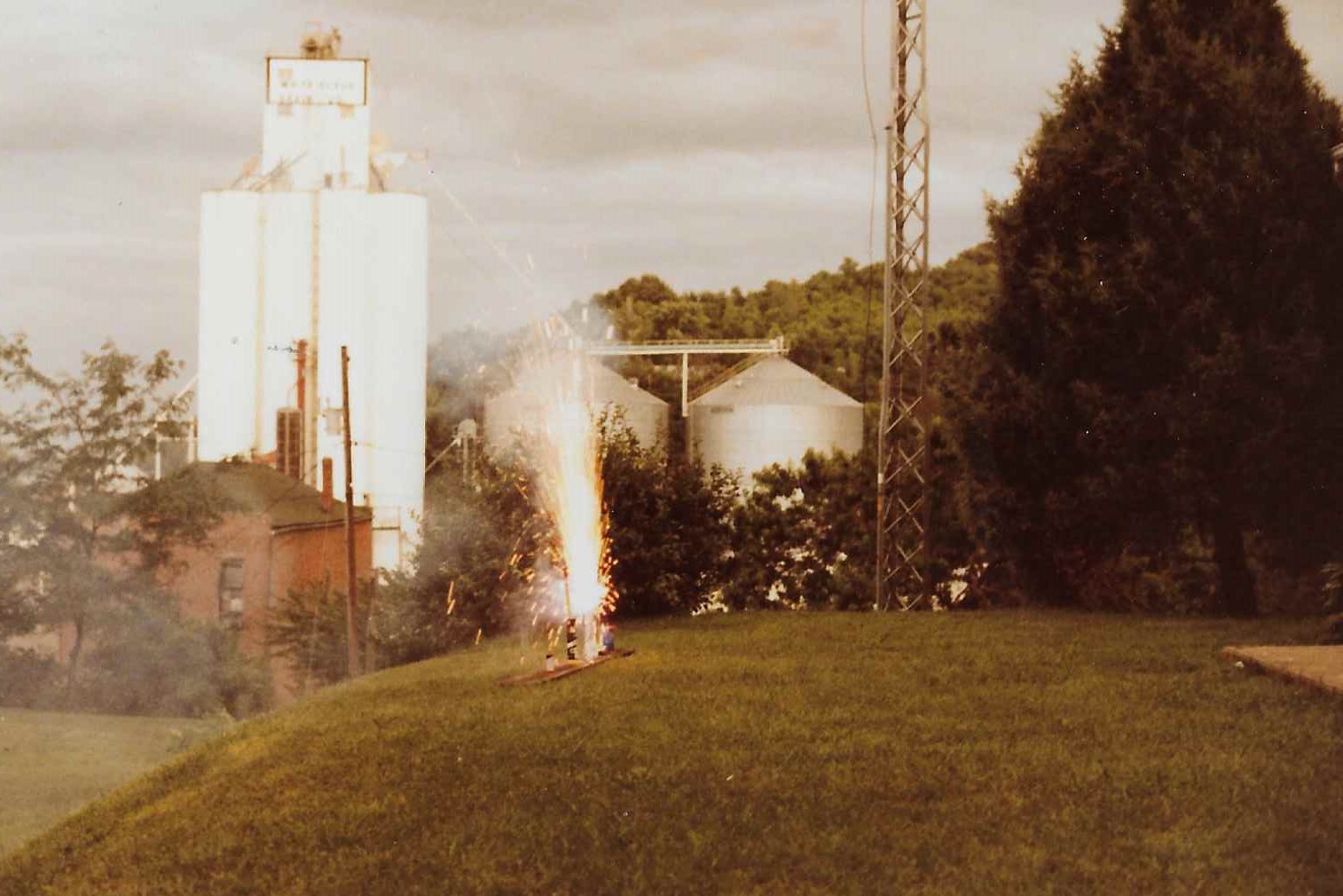
The second picture from the top looks north at the bending Missouri River from the Northern hill above the town. The bottom photograph (with my roommate Gary at the time and myself standing) is of the top of the Southern hill above the town. Uncle Robert owned the hill for years until his death. It passed to his often-estranged son, Ray Breeze, and none of us knows who owns that hill now (Ray attempted to sell off anything and everything he got from his late father before, during and immediately after the funeral). The photo second from the bottom looks across from Doris and Hap's front yard at the town's grain elevator. I have stood on the top on a few occasions over the years, beginning in 1966, and surveyed the town below, from the river end to the closed elementary school at the opposite end.
The photo of my Uncle Robert and mom includes the front porch of the Nuzum house that Robert later owned for a number of years, again until his death. But like most of the historic structures in the town, it became musty and broken down because Robert could not hold back time forever. Again, I have no idea if Cousin Ray (whom none of us knew at all until we briefly met him at Uncle Robert's funeral and did not take to him at all) was able to sell the house or if it's deteriorated well beyond repair. (It is in front of that house where the aged black and white photo was taken in 1921--from a different angle--of four generations of Hook/Nuzum/Breeze women, beginning with Great Great Grandmother Hook and ending with my infant mother in her lap, with Grandma Gladys Breeze and her mother, Great Grandma Nuzum, standing around Great Great Grandmother Hook.)
I currently have not found any photographs of the town's Olive Branch cemetery (though my mother took so many over the years). Grandpa Ray Breeze (Gladys's husband) was buried there in 1954 when he died of a sudden heart attack at the age of 55.
The reason these photographs are included here is because the tenth volume in the series, RAINBOW ARC OF FIRE: OLIVE BRANCH, begins and ends in White Cloud, Kansas. Many of the sites depicted above are featured in the book, including the Olive Branch cemetery. Several of the super-hero characters in the book are staying there for the funeral of Aunt Doris and Uncle Hap in May of 2003.
